

For Micro Center stock inside a restock alert, a parts tracker or an AI agent, start with Scavio's Micro Center API. It is the one option here that returns the unit count at whichever of Micro Center's 31 stores you name, with every open-box unit and its price, the full spec table and a yes or no for every store, all behind one API key. Search and product calls cost 2 credits, the store list 1, and Scavio starts from $4 per 1,000 searches on the Growth plan billed yearly.
You need a third-party option because Micro Center has no public API. Its website shows a unit count only for the store you have selected, so knowing how many are left at each store means switching stores one by one, which is exactly what the stock checkers people post on GitHub and Reddit automate.
We build Scavio, so read this with that bias in mind. Every Scavio number below comes from live calls we made on November 2, 2026. Every competitor detail was read off the vendor's own page that day, and where a detail was not published we say so. The screenshots are each vendor's own Micro Center page, captured the same day.
Which Micro Center API fits your job?
| Tool | Choose it for | Stock by store | Open box | Price (checked Nov 2, 2026) |
|---|---|---|---|---|
| Scavio | Apps and agents that need any store's count, open box and specs | Unit count at any of 31 stores; yes/no for every store in one call | Count and lowest price in search; each unit with condition in product | From $4 per 1,000 searches (Growth, yearly); 2 credits a call; 50 free credits |
| Bright Data | Large files of product records by URL | Not documented; an availability field only | Not documented | $1.50 per 1,000 records; 5,000 free records a month |
| Apify actor (sian.agency) | Scheduled no-code exports by keyword | Store id input; every store's stock in detail mode | Not documented | From $4.75 per 1,000 overview products |
| StockSmart (open source) | One product at one store, run yourself | One store, set in code | No | Free (Apache-2.0); last commit November 2024 |
| Real Data API | A managed scraping service | Not stated | Not stated | Quote only |
| Actowiz Solutions | A custom data project | Not stated | Not stated | Quote only; general plans "from $500/mo" |
A Micro Center GPU is in stock somewhere, just not at every store
In our sweep Micro Center priced every part the same at every store, but stock is a per-store count, and a card that is gone in one city can be on the shelf in another. We searched "rtx 5070" at 11 Micro Center stores with Scavio, one call per store, all within two minutes.
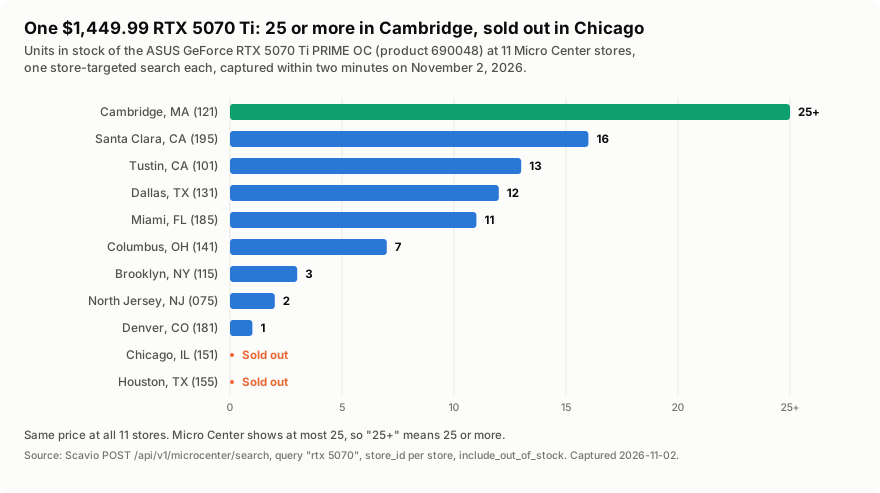
The ASUS GeForce RTX 5070 Ti PRIME OC cost $1,449.99 at all 11 stores. Cambridge, Massachusetts had 25 or more, Santa Clara 16 and Tustin 13, Denver had 1, and Chicago and Houston were sold out. Across the whole search, 45 RTX 5070 and 5070 Ti cards were carried at all 11 stores; 37 of them were sold out at one or more stores, only 8 were in stock at every store, and 3 were sold out at all 11. A shopper who checks only the nearest store, or a tool that returns one stock flag for the whole chain, misses where the cards actually are.
1. Scavio: the count at any store, open box and which stores have it
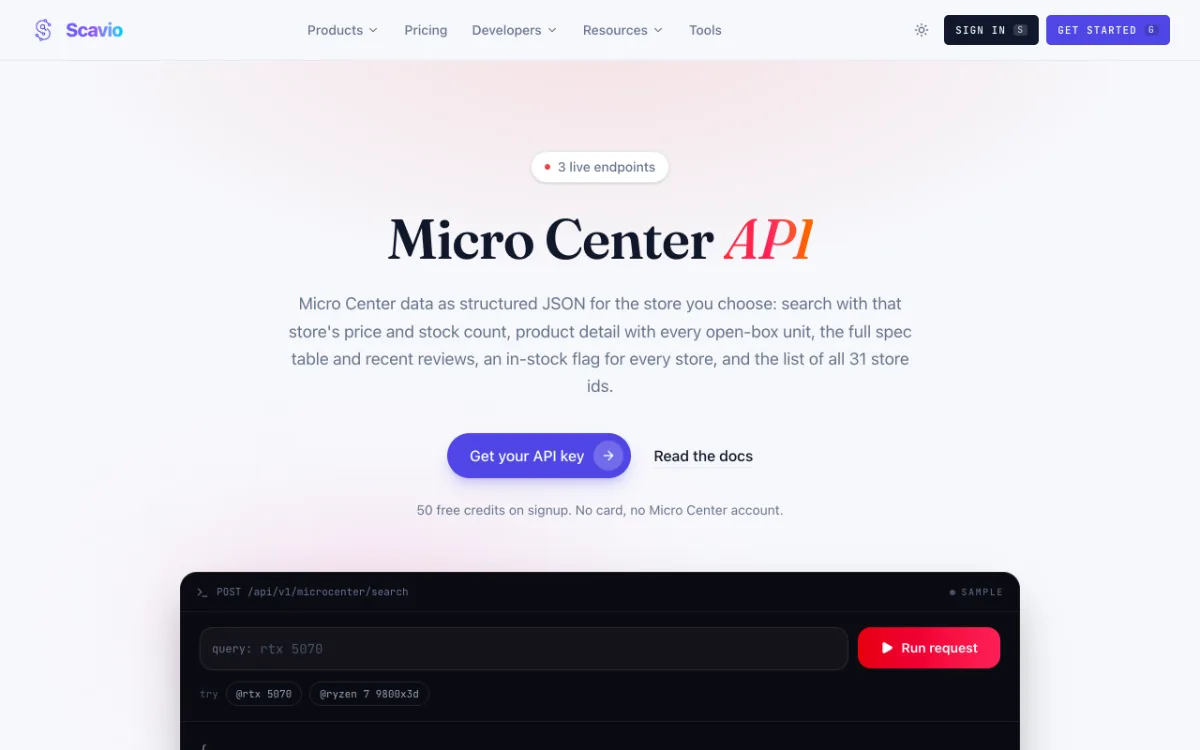
Scavio's Micro Center API is 3 POST endpoints. Measured on November 2:
- Search: "rtx 5070" at the Cambridge store returned 96 products a page from 1,096 matches in 3.9 s, each with price, original price, SKU and the store's stock as Micro Center prints it ("25+ IN STOCK") plus a parsed
quantity, aquantity_cappedflag andnot_carried. Open-box units show as a count and the lowest open-box price. The 11 searches behind the chart took 1.9 to 4.4 s each. 2 credits. - Product: the same RTX 5070 Ti at Cambridge returned the SKU, MPN, UPC, 37 spec rows, a 4.8 rating from 76 reviews with the 10 most recent, the store's count ("25+ NEW IN STOCK") and
stores_in_stock, a yes or no for all 31 stores plus the web store, in 4.3 s. At Santa Clara, an ASUS RTX 5070 Ti ProArt listed one open-box unit with its id, condition ("INCOMPLETE: AS IS"), warranty and price, $1,439.96 against $1,599.99 new. 2 credits. - Stores: all 31 stores with the 3-digit
store_idthe other calls take, city, state, address and ZIP. 1 credit.
What it does not do: Micro Center shows at most 25 units, so a count above that comes back as 25 with quantity_capped true. The per-store list in a product call is a yes or no, not a count, so a chain-wide count is one call per store, and each search or product call is 2 credits rather than 1. Items Micro Center sells as "Buy In Store" carry no online price, and the latest 10 reviews are all the product call returns. There is no stored history: you build one by calling on a schedule. The benefit is one key and one JSON format for Micro Center alongside Amazon, eBay and Walmart, plus an MCP server for agents. How to check Micro Center stock by store walks through each call with captured responses.
2. Bright Data: product records by URL
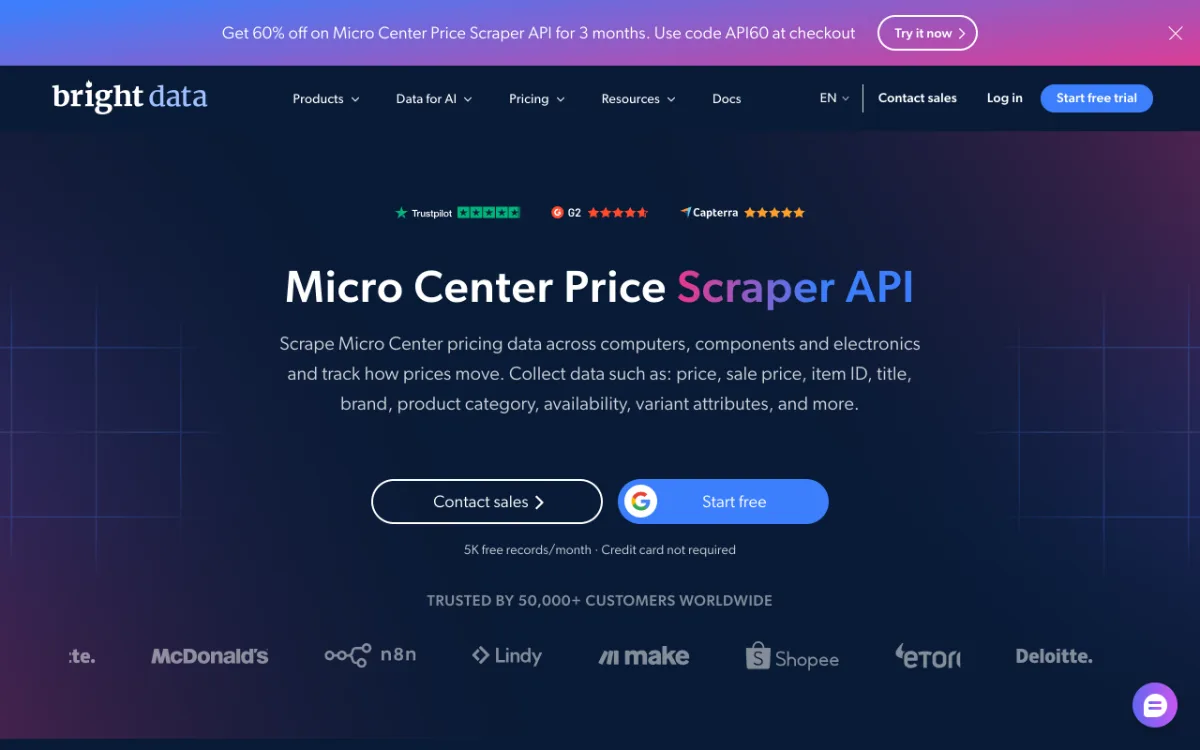
Bright Data's Micro Center Price Scraper API collects price, sale price, item id, title, brand, category, availability and variant attributes, and a separate products scraper adds GTIN, MPN, description and the category tree. Its examples take product URLs, up to 5,000 per request; keyword, store and ZIP inputs and a per-store stock field are not documented. It costs $1.50 per 1,000 records pay-as-you-go, or $499 a month for 384,000 records with more at $1.30 per 1,000, and the free tier is 5,000 records a month with no card. Choose it when you already have the product URLs and want a large file of prices.
3. Apify actor: scheduled keyword exports
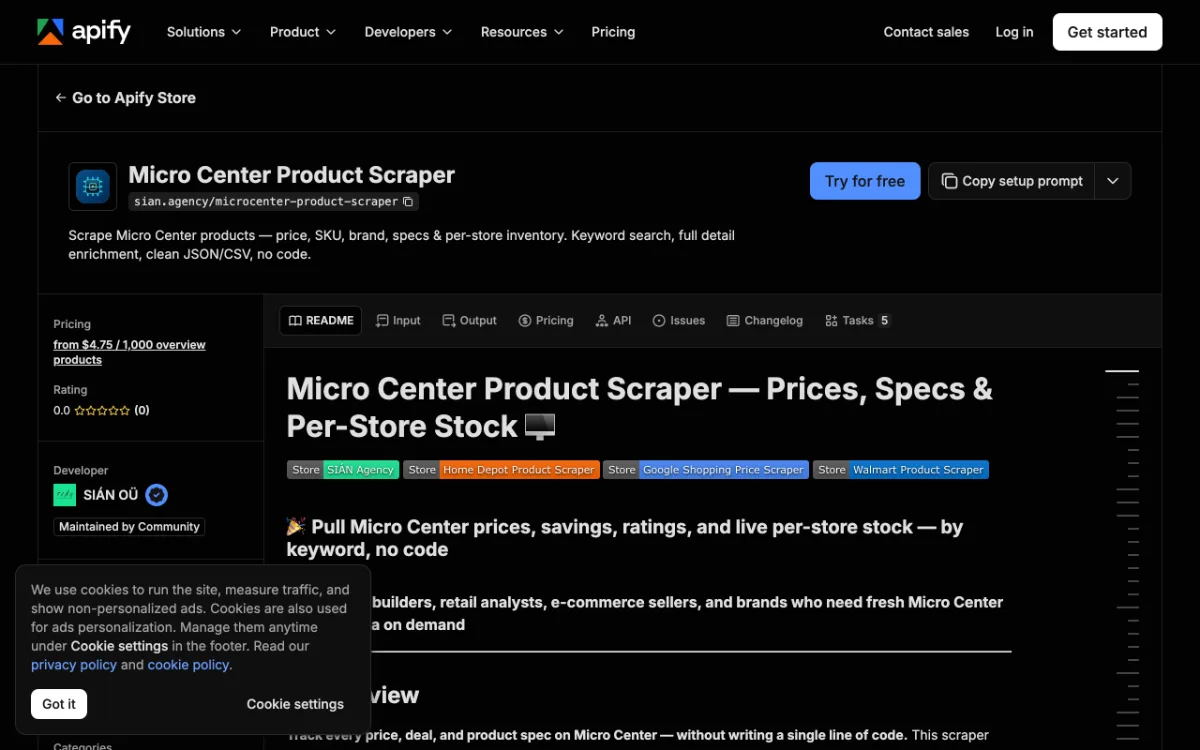
On the Apify Store, sian.agency/microcenter-product-scraper searches by keyword and takes a storeId (Westmont, store 025, by default) for that store's price and quantity on hand; its detail mode adds stock for every store. It had 36 users and no ratings on November 2, and charges from $4.75 per 1,000 overview products, with 25 products a run on the free tier. Open-box units are not mentioned. Other Micro Center actors exist, such as fortuitous_pirate/microcenter-scraper at 25 users, whose listing and README quote different prices. Actors run as jobs that write to a dataset, which suits scheduled exports more than a check inside a request, and each is maintained by its author, so pin the one you test.
4. StockSmart: an open-source checker for one product
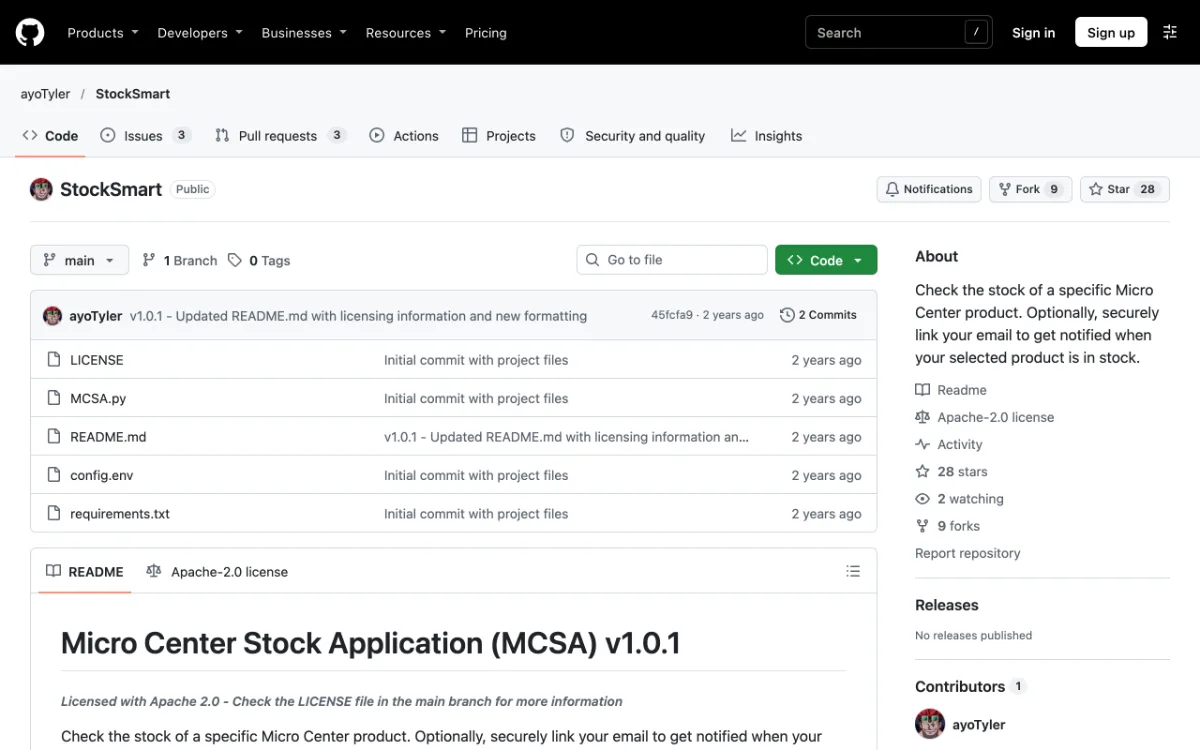
StockSmart is the Python script behind the r/Microcenter "Micro Center Stock Tool" post. Its README says the default code watches an AMD Ryzen 7 9800X3D at the Dallas store; you change the store number and product URL in the source, run it on your own machine and, optionally, get an email when the item is in stock. It is Apache-2.0 licensed with 28 stars and 9 forks, and its last commit was on November 30, 2024. Choose it if you want one alert for one part and are happy to keep a script running; it is not an API you can query for many products or stores.
5. Real Data API: a managed scraping service
Real Data API sells Micro Center data scraping with a list of 20 fields, including price, discount price, stock status, ratings, review count and shipping information. The page does not say whether stock is broken down by store, publishes no price and asks you to get a quote. Choose it if you would rather hand the job to a service than call an API.
6. Actowiz Solutions: a custom data project
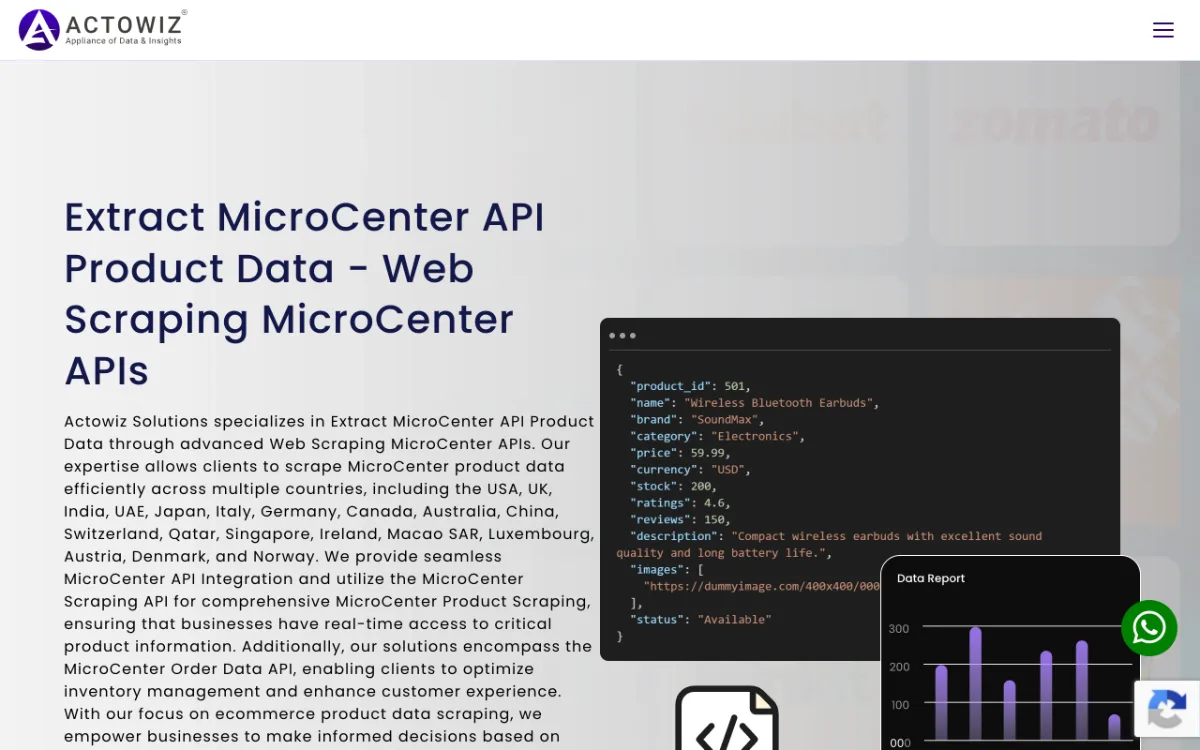
Actowiz Solutions offers Micro Center product data extraction as a service. Its page lists general plans "from $500/mo" and custom enterprise pricing behind a strategy call, with no Micro Center rate, and mentions stock availability without a per-store breakdown. Choose it for a one-off or recurring dataset someone else builds to your spec.
General scraping APIs can also fetch microcenter.com pages, but they return the page or their own parser's output rather than per-store stock fields; check what each returns for a store-specific product page before you compare.
Pick by the number you need
If your users act on whether a Micro Center near them has a part, how many are left and what open box costs, keeping those counts current is the ongoing work, and it is what Scavio's Micro Center API handles. Watching one search at the 5 stores nearest your users every hour is 120 searches a day, 7,200 credits a month and about $14 at the Growth-yearly rate of $2 per 1,000 credits. Sweeping all 31 stores every hour is 22,320 searches and 44,640 credits a month, about $89, and each search returns up to 96 products with that store's count. Billed per product at $4.75 per 1,000, the same coverage would be up to 2.1 million product rows a month. Try the Micro Center API free, 50 credits, no card, or try the endpoints in the playground.
Reference: all 3 Micro Center endpoints · search docs · product docs · stores docs · how to check Micro Center stock by store
Frequently asked questions
Does Micro Center have a public API?
No. Micro Center publishes no developer API for products, prices or store inventory, and its website shows a unit count only for the store you have selected. Developers use a third-party API, an Apify actor, a data service or an open-source checker instead. Scavio's Micro Center API returns any store's unit count, open-box units and specs as JSON with one key.
How do I check Micro Center stock at a specific store?
On the website you select a store and read the label on each product. Through an API, pass the store's 3-digit id: Scavio's search and product endpoints take a store_id and return that store's label, such as "16 IN STOCK", with the count parsed. Store ids come from its stores endpoint, which lists all 31 Micro Center stores.
How often does Micro Center restock GPUs?
Micro Center does not publish a restock schedule, and stock moves store by store. On November 2, 2026, one ASUS RTX 5070 Ti was sold out in Chicago and Houston while Cambridge had 25 or more, at the same price. Polling each store you care about on a schedule and alerting on a change from sold out to a count is the reliable way to catch a restock.
What is the cheapest way to track Micro Center stock?
An open-source checker such as StockSmart is free to run but watches one product at one store and stopped receiving commits in 2024. Bright Data is $1.50 per 1,000 records but documents no store-level output. Scavio is $4 per 1,000 search calls on its Growth plan billed yearly, and each search returns up to 96 products with the store's count.
Why does Micro Center show 25+ in stock?
Micro Center caps the count it displays at 25, so 25+ means 25 or more, not exactly 25. Scavio returns quantity 25 with quantity_capped true in that case. Below 25 the number is the store's own count, which is precise enough to tell a store with 1 unit left from one with 16.