

For Walgreens stock and prices inside an app, a restock alert or an AI agent, start with Scavio's Walgreens API. Its POST /api/v1/walgreens/stock call takes one product and up to 20 store numbers and returns the units in stock at each, for 4 credits: about $0.008 on the Growth plan billed yearly, under a cent for 20 stores. The same key searches walgreens.com with regular, sale and unit prices, coupons and promotions, returns product detail with ingredients and dated offers, and finds Walgreens and Duane Reade stores near a ZIP code.
Walgreens does run its own developer program, and it is covered below as option 2: its Store Inventory API returns per-store quantities to registered developers. What the program does not list is a catalog search or a price API, so product names, prices, coupons and ingredients have to come from somewhere else.
We build Scavio, so read this with that bias in mind. Every Scavio number below comes from live calls we made on November 2, 2026. Every other detail was read off the provider's own page or documentation that day, and where a detail was not published we say so. The screenshots are each provider's own Walgreens page, captured the same day.
Which Walgreens API fits your job?
| Tool | Choose it for | Store-level stock | Prices and product detail | Price (checked Nov 2, 2026) |
|---|---|---|---|---|
| Scavio | Apps and agents that need stock across stores plus prices, deals and product detail | Units at up to 20 stores per call; store finder by ZIP | Regular, sale and unit price, promotions, coupons, rewards; ingredients, warnings, dated offers | From $2 per 1,000 credits (Growth, yearly): search, product and stores 2 credits, stock 4; 50 free credits |
| Walgreens Store Inventory API | Apps built inside Walgreens' own developer program | One store per request: article id, quantity and update time | None in the inventory response; no catalog or price API listed | No price published; registration, API key and affiliate ID |
| Apify actors | Scheduled restock alerts across many stores | Units at up to 72 stores per ZIP; change-only mode | Sale and regular price, unit price, deals and rewards | Stock Checker: $0.98 per 1,000 product-at-store rows ($0.78 on Gold and above) plus $0.001 a run |
| Bright Data | Catalogue records by product URL | Not documented | Fields listed: title, description, brand, category tree, item and variant ids, URL | $1.50 per 1,000 records; $499/mo for 384,000; 5,000 free a month |
| iWeb Scraping | A managed feed built to order | "listings and locations"; store level not specified | Prices, discounts, stock status, reviews | Quote only; no price published |
Walgreens stock is a store-by-store question
Walgreens has more than 8,000 stores, and walgreens.com marks some products "Not sold online", so for many items the only stock that matters is on a shelf. We asked Scavio for the 20 Walgreens locations nearest Chicago ZIP 60614, all within 2.2 miles, then ran one stock call per product: four calls, 16 credits.
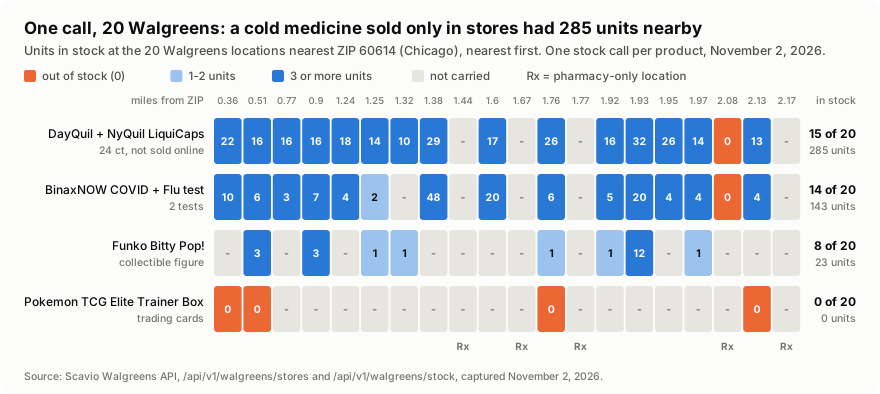
Vicks DayQuil and NyQuil Severe Cold & Flu LiquiCaps, 24 count, is the top seller in a "nyquil" search, and its product page reads "Not sold online". It was on the shelf at 15 of the 20 locations, 285 units in all, from 10 units at 1200 N Dearborn St to 32 at 757 N Michigan Ave. The 15 are every regular store in the list. The other five are pharmacy-only locations, a specialty pharmacy and pharmacies inside hospitals and clinics, so a stock checker should drop them before it counts.
The other rows show why the status matters as much as the number. The BinaxNOW COVID-19 and flu combo test was in stock at 14 locations, with 48 units at 3201 N Broadway St, and the store at 1200 N Dearborn St does not carry it at all. The Funko Bitty Pop! was carried by 8 stores with 23 units, 12 of them at one store, and not by the nearest store, 834 W Armitage Ave at 0.36 miles. The Pokemon Trading Card Game Elite Trainer Box was in stock nowhere: four stores carry it and were sold out, and the other 16 locations do not stock it. "Out of Stock" means a restock is possible; "Not Available" means it is not coming.
1. Scavio: units at 20 stores, prices, promotions and product detail
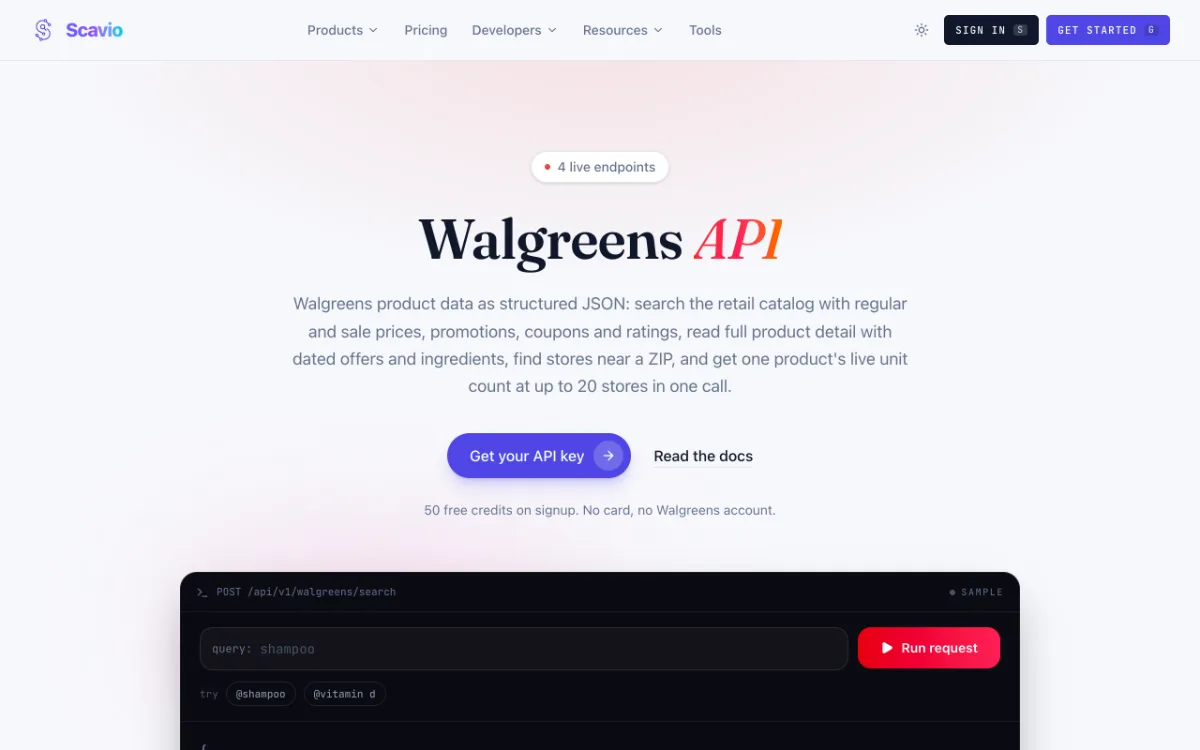
Scavio's Walgreens API is 4 POST endpoints. Measured on November 2:
- Stores: ZIP 60614 returned the 20 nearest of 441 locations within 25 miles in 1.6 s, each with store number, brand, address and cross streets, phone, coordinates, distance, opening and closing time and store page URL. Around New York ZIP 10001, 9 of the nearest 10 were Duane Reade stores, which the same call covers. Up to 25 stores a page.
- Stock: one product at up to 20 store numbers, each with
status(In Stock, Out of Stock or Not Available),quantityandin_stock, plusin_stock_countacross all of them. Our six stock calls took 2.8 to 5.6 s. 4 credits. - Search: "nyquil" sorted by top sellers returned 54 products in 3.9 s, up to 70 a page, each with regular and sale price, multi-buy text, unit price, coupon, promotion, rewards and rebate messages, rating, review count and UPC. 33 were on sale, 38 carried a coupon such as "$1.50 off 2 Coupon" and 14 a promotion such as "Buy 1, Get 1 50% OFF". 2 credits.
- Product: the DayQuil and NyQuil LiquiCaps returned the UPC and GTIN, a $16.99 regular price with "2/$26.00 or 1/$13.99", savings of $3 (18%), a unit price of $0.58 each, both products' active ingredients, the liver warning, a three-level category path, seven images, the FSA flag and the "Not sold online" message, in 2.1 s. 2 credits.
What it does not do: prices are walgreens.com's published prices and do not change with the store, so there is no per-store shelf price. One stock call covers one product at 20 stores; a wider area or a watch list means more calls, and there is no built-in change tracking. There is no review text, only rating and review count, nothing from the pharmacy, and stock costs twice a search. The benefit is one key, issued at signup, and one JSON format for Walgreens alongside CVS, Walmart, Target and Dollar General, plus an MCP server for agents. How to get Walgreens product data and store stock walks through each call with captured responses.
2. Walgreens Store Inventory API: the official counts, one store at a time
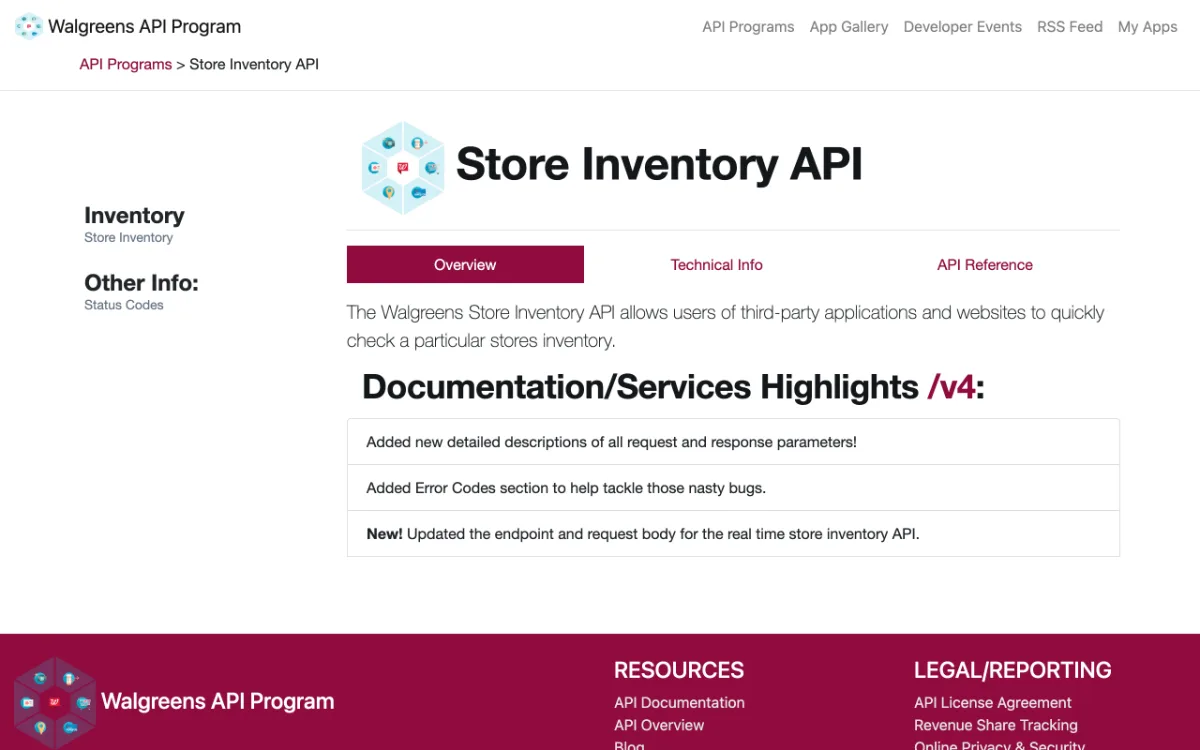
The Walgreens API Program lists six APIs: Photo Prints, Rx Refill or Transfer, Scheduling, Add to Cart, Store Inventory and Store Locator, the last covering 8,000+ Walgreens and Duane Reade stores. The Store Inventory API, now on version 4, "allows users of third-party applications and websites to quickly check a particular stores inventory." A request is a POST carrying your API key, an affiliate ID, one store number and your app version; the documented response is a list of rows with the product's article id, the store, the quantity in stock and an update time. The documentation marks it as not rate limited, and no price is published.
To use it, you register on the portal and request a key for an app under My Apps. Integrations follow Walgreens' brand guidelines, and the program's terms let Walgreens "reject, terminate, or modify any party's registration or Participation at any time for any reason". We did not apply, so we cannot say how long approval takes or which apps are accepted. The response carries no product names or prices and the program lists no search or price API, so you match article ids to products yourself; Scavio's search, product and stock responses each include an article_id. Choose it if you are building the kind of app Walgreens' program is designed for and you only need counts straight from the source.
3. Apify actors: restock alerts on a schedule
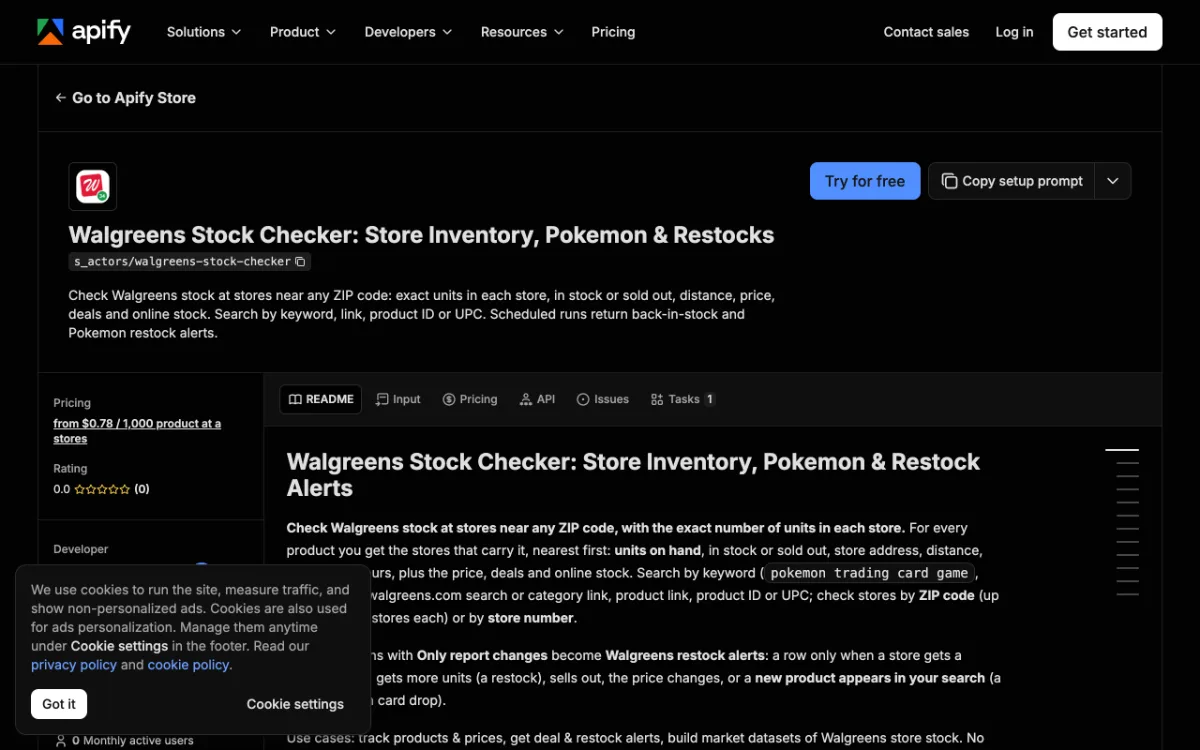
The Walgreens Stock Checker actor is the closest match to Scavio's stock call and goes further on monitoring. It takes keywords, walgreens.com links, product ids or UPCs with ZIP codes or store numbers, and returns units on hand per store with price, deals and online stock, for up to 72 stores per ZIP. An "Only report changes" mode turns scheduled runs into back-in-stock, restock, sold-out and price-drop alerts, and unchanged rows are not billed. It costs $0.98 per 1,000 product-at-store rows on Apify's Free and Bronze plans, $0.88 on Silver and $0.78 on Gold and above, plus $0.001 a run. It was published on October 10, 2026 and had 9 users, 52 runs and no ratings yet. For catalogue pulls, Walgreens Product Scraper returns prices, discounts, ratings, UPCs and product detail at $0.99 per 1,000 results plus $0.0005 a run, with 14 users. Each actor is maintained by one developer, so pin the one you test.
4. Bright Data: catalogue records by URL
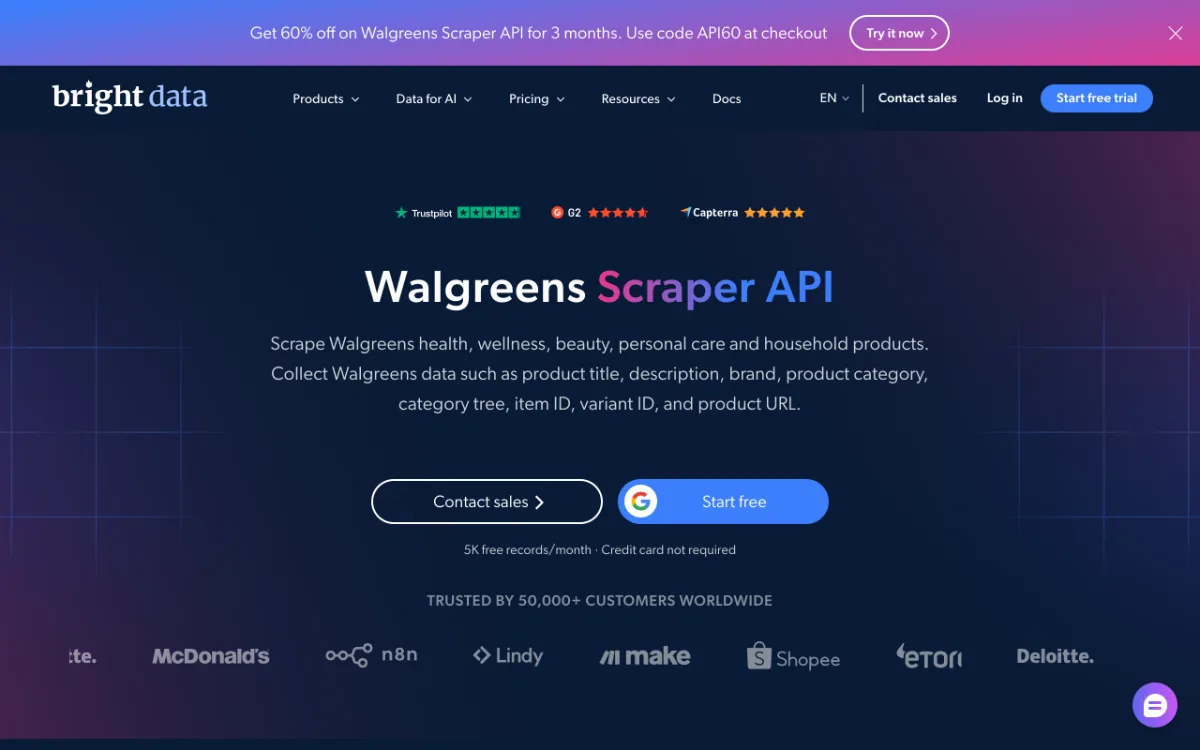
Bright Data's Walgreens Scraper API takes up to 5,000 product URLs per call, with a separate collector that discovers products from the sitemap. The fields its page lists are product title, description, brand, category, category tree, item id, variant id and URL; it does not list price, stock or store fields. It costs $1.50 per 1,000 records pay-as-you-go or $499 a month for 384,000 records with more at $1.30 per 1,000, every account gets 5,000 free records a month, and the page carried a 60% discount code for three months. Choose it for a file of what Walgreens sells, not for what a given store has.
5. iWeb Scraping: a managed feed on a quote
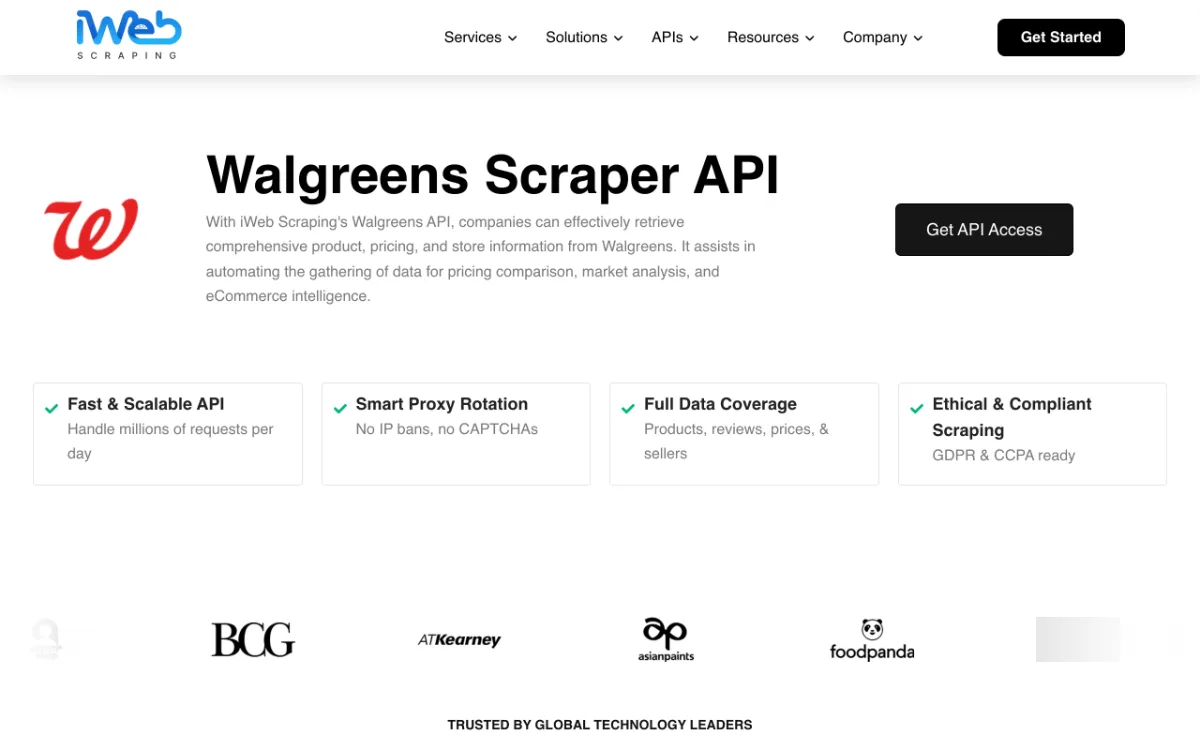
iWeb Scraping's Walgreens API page promises product titles, descriptions, categories, pricing, discounts, stock status, images and reviews, exported as JSON or CSV, and says it can "monitor stock status and product availability across Walgreens listings and locations" without describing per-store fields. Access starts with a contact form ("Get API Access" and "Get Custom Quote"), and no price is published. Choose it if you want a vendor to build and run a custom Walgreens feed for you.
Channel3 also has a Walgreens product data page for its cross-retailer search API, with 1,000 free searches a month and no store stock documented.
Pick by the number you need
If your users act on whether a nearby Walgreens has an item, keeping those counts current is the ongoing work, and it is what Scavio's Walgreens API handles. Watching 50 products around 5 ZIP codes twice a day is 500 stock calls a day, 2,000 credits and about 60,000 a month: $120 at the Growth-yearly rate of $2 per 1,000 credits, for 10,000 store counts a day, about $0.40 per 1,000 counts. Billed per product-at-store row at $0.98 per 1,000, the same 300,000 rows a month would be about $294, though a change-only schedule bills far fewer rows when stock rarely moves. For one neighbourhood, 20 products at one ZIP once a day is 2,400 credits a month, about $4.80. Try the Walgreens API free, 50 credits, no card, or try the endpoints in the playground.
Reference: all 4 Walgreens endpoints · stock docs · stores docs · search docs · how to get Walgreens product data · checking Walgreens inventory at nearby stores
Frequently asked questions
Does Walgreens have an API for product data?
Walgreens runs a developer program at developer.walgreens.com with six APIs: Photo Prints, Rx Refill and Transfer, Scheduling, Add to Cart, Store Inventory and Store Locator. The Store Inventory API returns per-store quantities keyed by article id for registered developers with an API key and affiliate ID. The program lists no catalog search or price API, which is the gap third-party APIs such as Scavio's Walgreens API fill.
How do I get access to the Walgreens Store Inventory API?
Create an account on developer.walgreens.com and request an API key for your app under My Apps. Requests also carry an affiliate ID, integrations follow Walgreens' brand guidelines, and the program's terms let Walgreens reject or end any registration at its discretion. Walgreens does not publish approval criteria or timing.
Can I check Walgreens stock at several stores at once?
Yes. Scavio's stock endpoint takes one product id and up to 20 store numbers and returns each store's status, unit count and in_stock flag in one 4-credit call; the stores endpoint turns a ZIP into those store numbers. Apify's Walgreens Stock Checker actor checks up to 72 stores per ZIP in a run. Walgreens' own Store Inventory API takes one store per request.
Are Walgreens prices the same at every store?
The prices walgreens.com publishes do not change with the store you pick: in Scavio's product response store_pricing is false, and search returns the same regular price, sale price and promotions whichever store_id you pass. What changes store by store is stock, which is why the useful per-store call is a stock check.
What is the cheapest Walgreens inventory API?
For counts across stores, Scavio's stock call costs 4 credits for up to 20 stores, about $0.40 per 1,000 store counts on the Growth plan billed yearly. Apify's Stock Checker charges $0.98 per 1,000 product-at-store rows on its Free and Bronze plans and $0.78 on Gold, but its change-only mode bills only rows that changed. Walgreens' own Store Inventory API publishes no price.