

For Google Trends data inside an app, a dashboard or an AI agent, start with Scavio's Google Trends API. POST /api/v2/google/trends returns a term's interest over time, its interest by state, metro or city, and its related queries and topics as JSON, and up to five comma-separated terms come back on one shared 0-100 scale in a single call. POST /api/v2/google/trending returns the searches trending in a country right now, each with a search-volume figure, growth and start time. One term costs 1 credit, a comparison 3, and Scavio starts from $1 per 1,000 credits on the Growth plan.
Most teams that ask for a Google Trends API have run into pytrends. The library is archived on GitHub, its last release was in April 2023, and its own README warns that it is "only good until Google changes their backend again". Google now has an official answer: on July 24, 2025 it announced the Google Trends API in alpha, with consistently scaled data over about five years. Access is still by application, and Google's API page says it "can't open the API for everyone yet". If you are accepted, use it. If you are not, or you need trending searches and related queries today, the hosted APIs below return what the Trends website shows.
We build Scavio, so read this with that bias in mind. Every Scavio number below comes from live calls we made on November 29, 2026. Every competitor detail was read off the vendor's own page or documentation that day, and where a detail was not published we say so. The screenshots are each vendor's own Google Trends page, captured the same day.
Which Google Trends API fits your job?
| Tool | Choose it for | Terms per request | Trending now | Price (checked Nov 29, 2026) |
|---|---|---|---|---|
| Scavio | Apps and agents that need series, regions, related queries and trending searches with one key | Up to 5 on one 0-100 scale | Yes: search volume, growth, start time and status | 1 credit a term, 3 a comparison; $1 per 1,000 credits on Growth; 50 free credits |
| SerpApi | Teams already using SerpApi for Google | Up to 5 for interest over time and compared breakdown by region | Separate Trending Now API | $25/mo for 1,000 searches to $150 for 15,000 ($10 per 1,000); 250 free a month |
| DataForSEO | SEO pipelines that can wait for a queue | Priced on 5 keywords per task in its example | Not listed on its Trends page | $0.0027 a task (standard queue) or $0.011 (live); $50 minimum top-up; $1 trial credit |
| Bright Data | High volume billed per successful request | Timeseries and geo map widgets | "Recently trending" listed as a data type | $1.50 per 1,000 requests; $499/mo for 380,000; 5,000 free a month |
| SearchApi | One SERP plan that also covers Trends | Up to 5 in TIMESERIES | Separate Google Trending Now engine | $40/mo for 10,000 searches ($4 per 1,000) to $5,000 for 5M; 100 free requests |
| Glimpse | Estimated absolute search volume next to the 0-100 index | Not stated on its API page | Not on its API page | Not published on its API page; access by request |
A Trends number only means something next to the terms it was asked with
Google scales every Trends request so that its highest point is 100. That makes a value meaningless on its own: it is a share of the peak of whatever else was in the same request. We asked Scavio for US interest in ChatGPT, Gemini, Claude, Perplexity and Copilot over the past 12 months in one call, then asked for Claude alone.
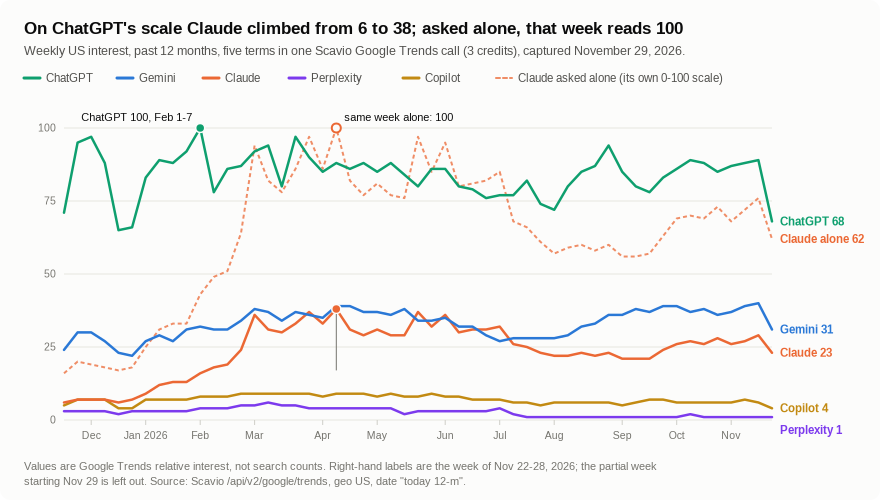
In the comparison, ChatGPT's busiest week was February 1-7, 2026, so that week is 100 and everything else is measured against it. Claude rose from 6 in the week of November 23-29, 2025 to a peak of 38 in the week of April 12-18, 2026, level with Gemini's 39 that week, and stood at 29 in the week of November 15-21. Perplexity went the other way, from 3 to 1, and Copilot stayed between 4 and 9 all year. Four of the five dropped in Thanksgiving week: ChatGPT went from 89 to 68.
Asked alone, Claude reads 100 for April 12-18, because it is now the peak of its own request. The growth is the same either way (16 to 76 alone, 6 to 29 in the comparison, about 4.8 times in both), but the levels cannot be mixed. A dashboard that stitches single-term calls together would put Claude on a par with ChatGPT. Put terms you want to compare in the same request, five at most, and when you need more than five, repeat one anchor term in every group. Google's official alpha removes this problem with consistent scaling, for the developers it admits.
1. Scavio: series, regions, related queries and trending now behind one key
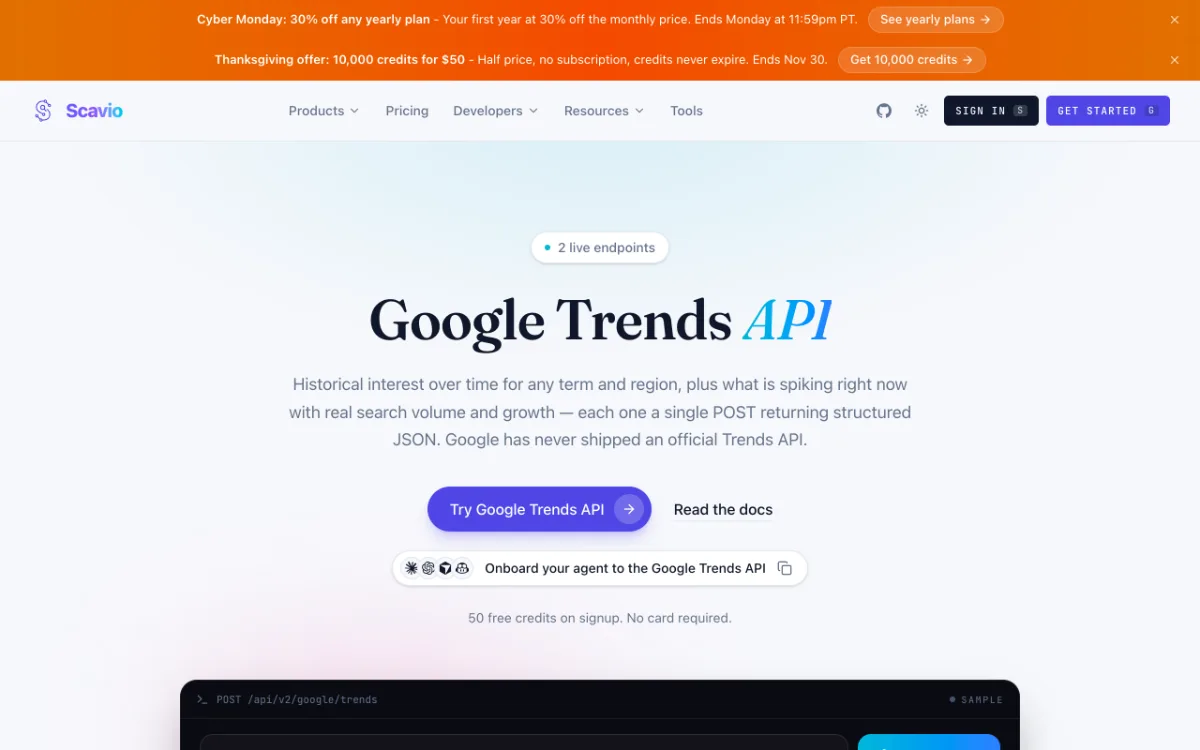
Scavio's Google Trends API is 2 POST endpoints. Measured on November 29:
- Interest over time: "ai agents" in the US over 12 months returned 54 weekly points and 51 regions in 3.8 s, peaking at 100 in the week of June 7-13, 2026. A
dateofnow 7-dreturned 169 hourly points instead: "black friday" peaked at 100 on November 27 at 4:00 AM in the response's time zone. 1 credit. - Comparisons: the five-term call above took 5.0 s. Each timeline point carries one value per term, and each region carries every term's share. 3 credits.
- Regions: the default breakdown is by state. With
data_typeGEO_MAPandregionDMA, "claude" returned 210 US metro areas, led by San Francisco-Oakland-San Jose at 100 and Lafayette, Indiana at 93. - Related queries and topics: "ai agents" returned 25 top and 24 rising queries; the top one was "best ai agents" and the fastest riser was "openclaw", marked Breakout. "claude" returned 22 top and 15 rising topics, with "Claude Code" rising as a Breakout.
- Trending now: the US over the past 24 hours, sorted by volume, returned 525 searches in 0.6 s, 156 of them still active, each with
search_volume,growth_percentage, astarted_attimestamp, its category and the related searches Google groups under it ("earthquake today" carried 196). 1 credit.
What it does not do: values are Google's relative index, not absolute counts, and trending volumes are Google's bands (111 of the 525 searches read 2,000) rather than exact numbers. A comparison costs 3 credits where SerpApi and SearchApi bill one search. The newest timeline point is the week in progress and carries no partial flag, and timestamps default to a UTC-7 offset unless you pass tz. There is no stored history, so you build your own by calling on a schedule. The benefit is one key and one JSON format for Trends alongside Google Search, Google News and Reddit, plus an MCP server for agents and an n8n node. How to get Google Trends data without pytrends walks through each call with captured responses.
2. SerpApi: every Trends widget plus Trending Now
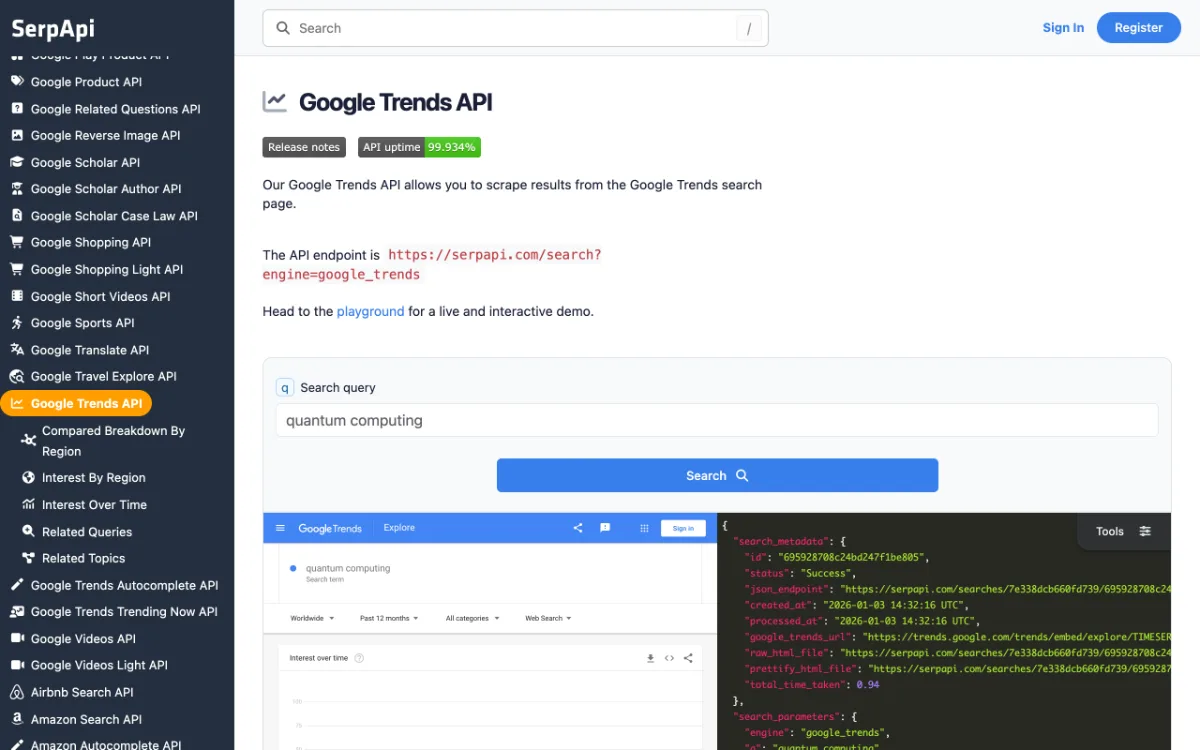
SerpApi's Google Trends API takes the five widget types (TIMESERIES, GEO_MAP, GEO_MAP_0, RELATED_TOPICS, RELATED_QUERIES), up to 5 queries for interest over time and compared breakdown by region, date ranges from the past hour to 2004 onward, and several date ranges or locations in one TIMESERIES request. Its separate Trending Now API returns search_volume, increase_percentage and start_timestamp for windows of 4, 24, 48 or 168 hours, and it also has a Trends autocomplete API. Pricing is per search: 250 free a month, $25 for 1,000, $75 for 5,000 and $150 for 15,000 ($10 per 1,000), and cached searches are free. Choose it if your team already runs Google searches through SerpApi and wants one vendor and the widest set of request options.
3. DataForSEO: queued Trends tasks for SEO pipelines
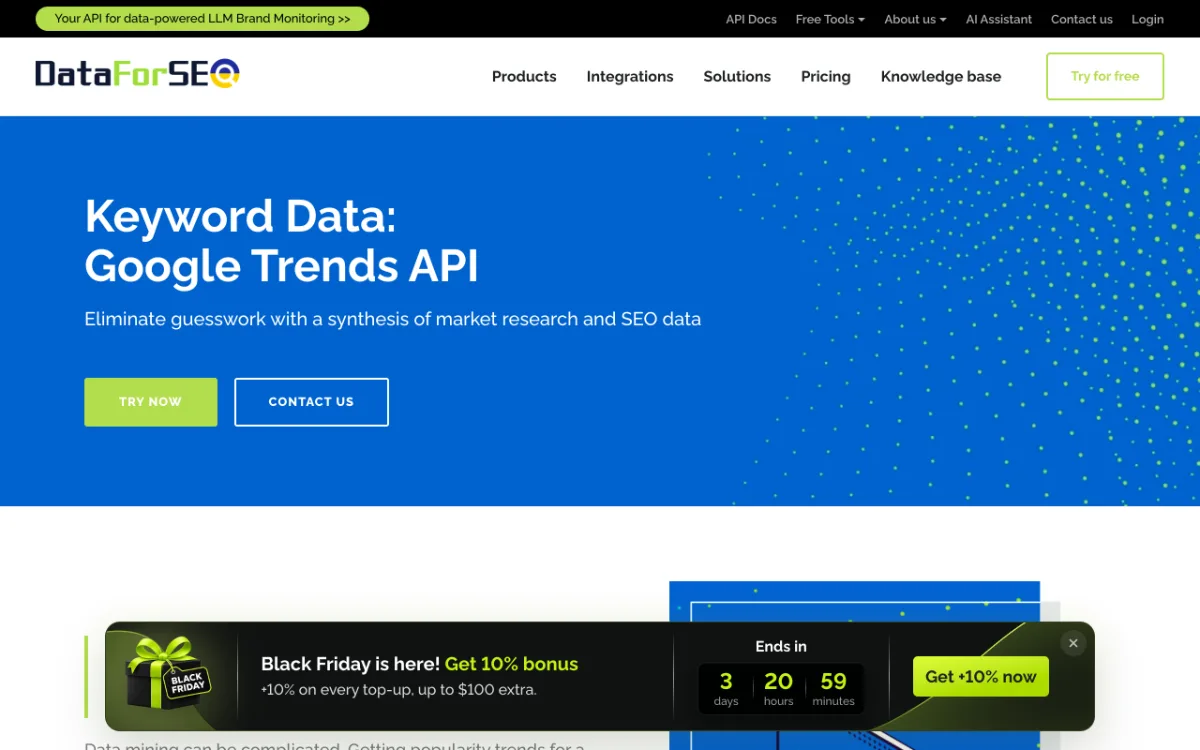
DataForSEO's Google Trends API returns location-specific keyword trends plus related topics and queries. It bills per task: $0.0027 in the standard queue, with results within 45 minutes, or $0.011 live, averaging up to 32 seconds, figures its page bases on tasks of 5 keywords. Accounts are pay-as-you-go with a $50 minimum top-up, a $1 trial credit and a balance that does not expire. Choose it if your keyword research already runs on DataForSEO and can wait for a queue.
4. Bright Data: per-request billing at volume
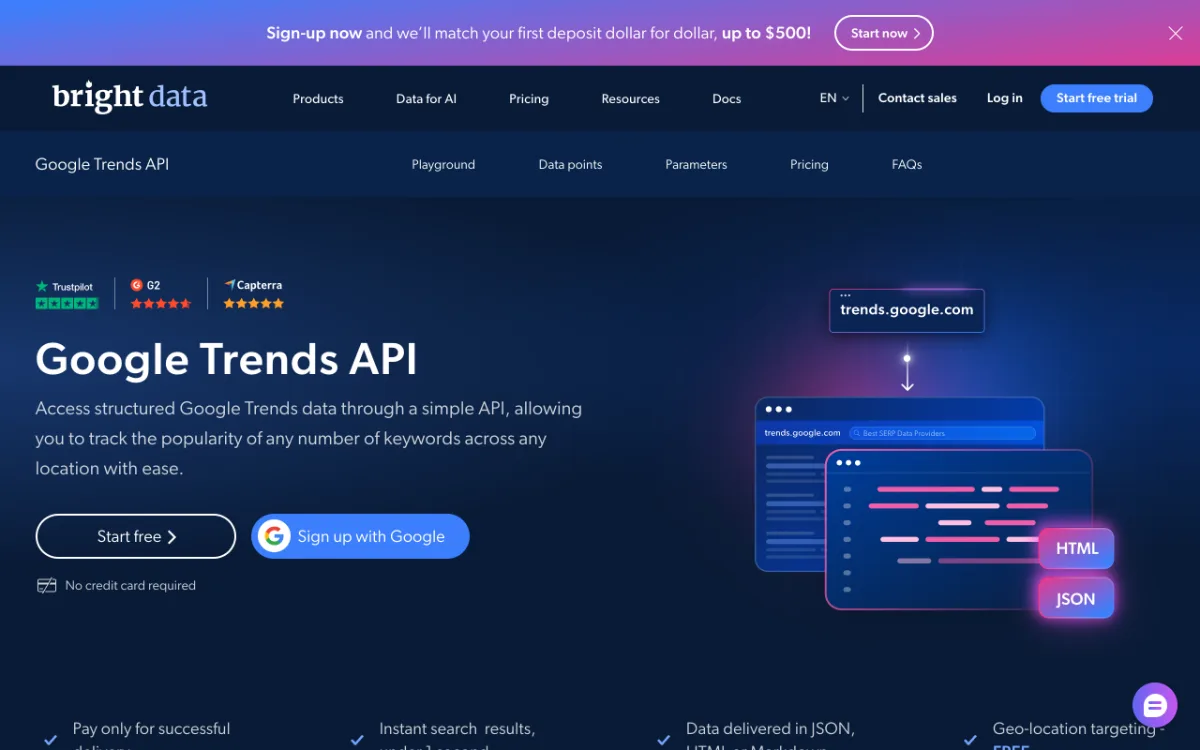
Bright Data's Google Trends API sits inside its SERP API. Its page lists search terms, topics, latest stories, recently trending and year in search as data types, timeseries and geo map widgets as parameters, and JSON, HTML or Markdown output. It costs $1.50 per 1,000 requests pay-as-you-go, or $499 a month for 380,000 requests and $1.30 per 1,000 after that, with 5,000 free a month and no card. Choose it when Trends is one of many SERP jobs you already run through Bright Data.
5. SearchApi: Trends on a general SERP plan
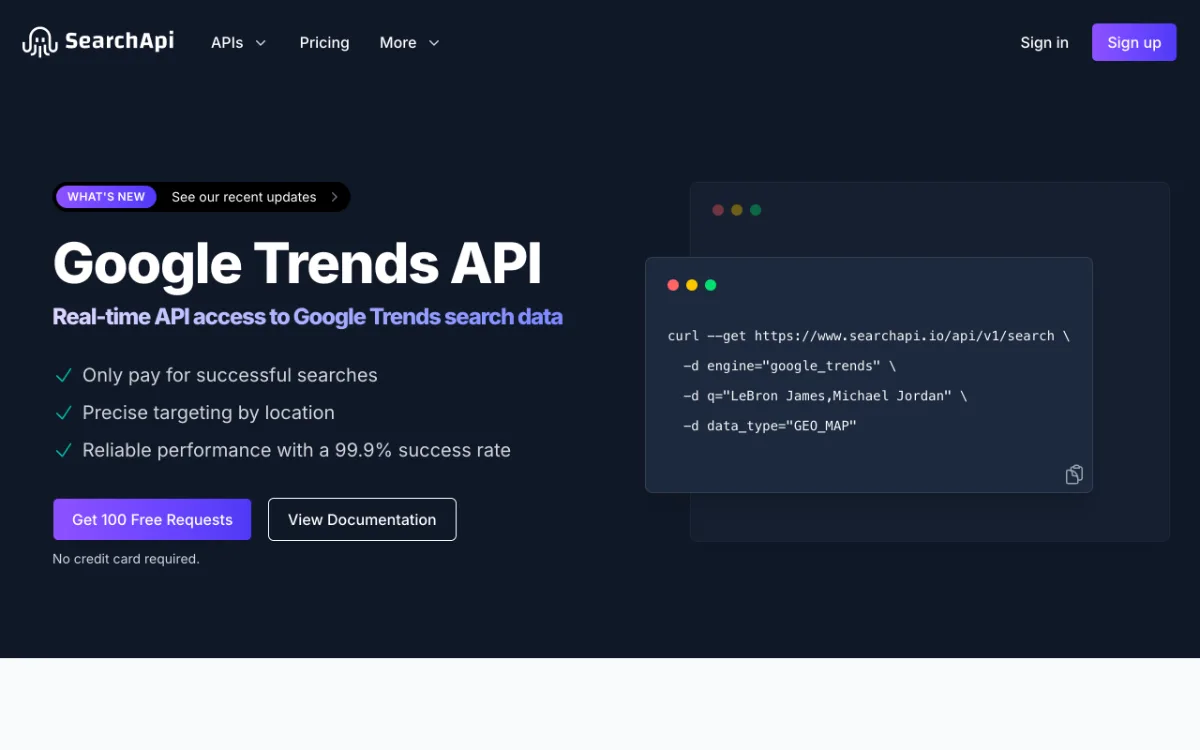
SearchApi's Google Trends engine takes TIMESERIES, GEO_MAP, RELATED_QUERIES and RELATED_TOPICS, with up to 5 comma-separated queries in TIMESERIES, and its docs list separate Google Trending Now and Trending Now News engines. Plans run from $40 a month for 10,000 searches and $100 for 35,000 to $5,000 for 5 million, you pay only for successful searches, and new accounts get 100 free requests. Choose it if you want Trends on the same plan as Google Search, Maps and the other engines it covers.
6. Glimpse: estimated absolute volumes next to the index
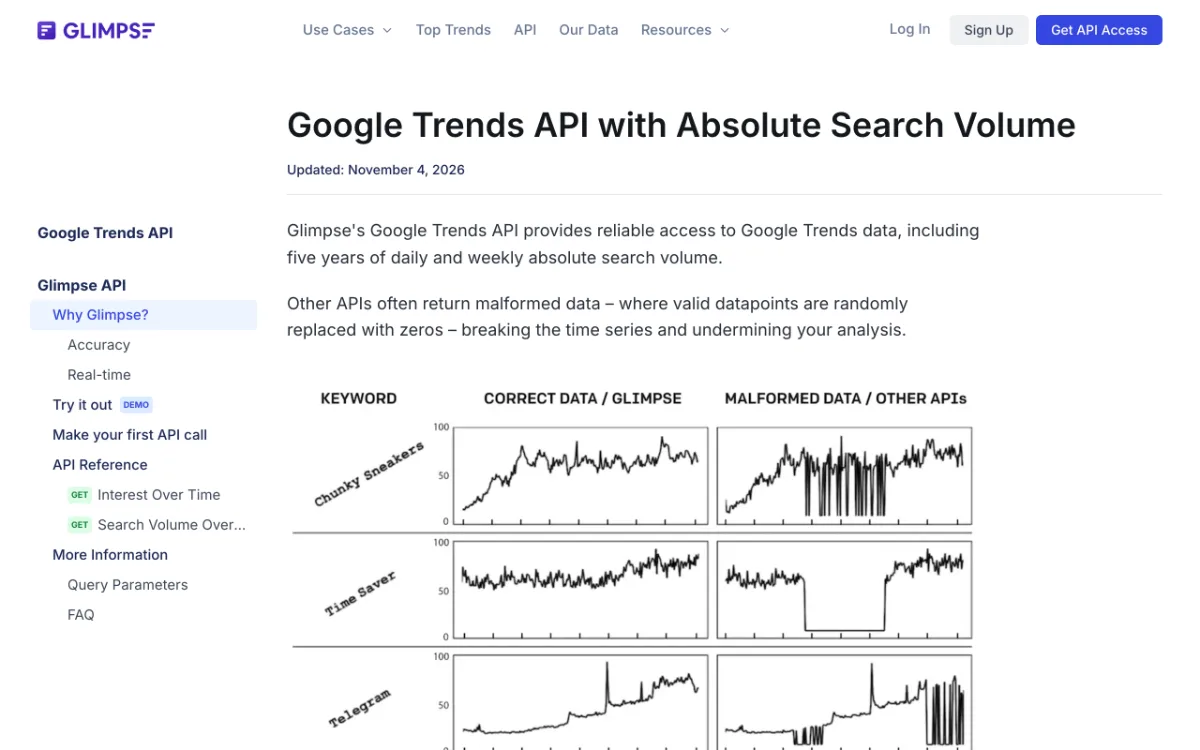
Glimpse's Google Trends API has two endpoints: interest over time normalised to 100, and search volume over time, which converts Trends signals into estimated absolute search volumes, both for five years at daily or weekly resolution. Its page invites you to request API access and to contact it for higher rate limits or more than five years of history; no price is published there. Choose it when the question is "how many searches", not "how much more than last month", and you accept an estimate.
Apify Store actors, including one billed as a pytrends alternative, also return Trends data as scheduled jobs that write to a dataset; each is maintained by its author and priced per result, so pin and test the one you pick.
Pick by the number you need
If your product shows whether a term is rising, what is spiking today, or which region cares most, keeping those calls running is the ongoing work, and it is what Scavio's Google Trends API handles. Tracking 200 keywords every week as 50 comparisons of 4 keywords plus one shared anchor is 150 credits a week, about 650 a month: $0.65 at the Growth rate of $1 per 1,000 credits. Polling trending searches in 5 countries every hour is 3,600 calls and 3,600 credits a month, $3.60 at the same rate. Try the Google Trends API free, 50 credits, no card, or try both endpoints in the playground. No code yet? The free Trends explorer and keyword comparison tools run on the same endpoints.
Reference: both Google Trends endpoints · trends docs · trending docs · how to get Google Trends data without pytrends · Google Trends in n8n without an empty output
Frequently asked questions
Does Google have an official Google Trends API?
Yes, in alpha. Google announced the Google Trends API on July 24, 2025 for a very limited number of testers, and its page still says it cannot open the API for everyone yet; you apply through a form. It covers a rolling window of about five years with daily, weekly, monthly and yearly aggregation, and its values are scaled consistently across requests rather than 0-100 per request. Until you have access, third-party APIs such as Scavio's Google Trends API return the same widgets you see on the Trends website.
Does pytrends still work?
pytrends is archived on GitHub, which makes it read-only. Its last commit was in August 2024, its last PyPI release was 4.9.2 in April 2023, and its README says it is only good until Google changes its backend again. A Reddit thread from January 2026 reports HTTP 400 errors from it, and 429 rate-limit errors are a long-running complaint. A hosted Google Trends API returns interest over time, interest by region and related queries without you maintaining that code.
Are Google Trends numbers real search volumes?
No. Interest over time and interest by region are relative: each request is scaled so its highest point is 100. On November 29, 2026 Claude's week of April 12-18 read 38 when compared with ChatGPT and 100 when asked alone. Trending searches are different: Scavio's trending endpoint returns a search_volume band for each search, such as 1,000,000 or 2,000, and Glimpse sells estimated absolute volumes.
Can I compare more than five terms in Google Trends?
Not in one request on the Trends website or on most APIs that mirror it: Scavio, SerpApi and SearchApi all take up to five comma-separated terms. To compare more, keep one anchor term in every group of five and rescale each group by the anchor's value. Google's official alpha API is built for comparing dozens of terms at once, for approved testers.
What are the top trending searches on Google right now?
It changes by the hour, so ask an API. At 02:46 UTC on November 29, 2026, Scavio's trending endpoint returned 525 US searches from the past 24 hours, led by 'earthquake today' with a search_volume of 1,000,000, then 'real madrid vs alavés', 'osu vs michigan' and 'auburn vs alabama' at 500,000 each. 328 of the 525 were in the sports category.