

For Etsy listings and prices inside an app, a competitor tracker or an AI agent, start with Scavio's Etsy API. POST /api/v1/etsy/search returns a page of listings for any keyword with the price, and on a sale item the pre-sale price and discount percentage, plus the shop, a free-shipping flag and an is_ad flag. /shop then returns the shop's review count, rating, admirers, listing count and opening year, /shop/products lists its catalogue and /reviews pages its reviews, all with one API key and no Etsy developer app. Every call is 2 credits, $2 per 1,000 requests on the Growth plan.
Etsy does have an official API. Etsy Open API v3 needs a registered app, and its own documentation describes a Seller App as access to your own shop only; building beyond your own shop takes a Personal App, which Etsy reviews and allows "at a limited scale". If your app qualifies, it is the official route. If you need to research other shops without an app review, or want the same JSON format as your other marketplaces, a third-party API fills the gap.
We build Scavio, so read this with that bias in mind. Every Scavio number below comes from live calls we made on November 29, 2026. Every competitor detail was read off the vendor's own page or documentation that day, and where a detail was not published we say so. The screenshots are each vendor's own page, captured the same day.
Which Etsy API fits your job?
| Tool | Choose it for | Listings and prices | Shops and reviews | Price (checked Nov 29, 2026) |
|---|---|---|---|---|
| Scavio | Apps and agents that need prices, sale depth and the shop behind each listing | Keyword search with price, pre-sale price, discount, ad and free-shipping flags; full listing detail | Shop profile, shop listings, shop-wide paginated reviews | 2 credits a call: $2 per 1,000 requests (Growth); 50 free credits |
| Etsy Open API v3 | Apps for your own shop, or approved apps beyond it | Active listing search and listing detail | Shop and shop review endpoints | No fee listed; app registration and review |
| Apify actors | Scheduled exports, including in-cart counts | Search and listing actors | Shop and review actors from several authors | $3.40 per 1,000 results (epctex, Apify free plan) to $8 per 1,000 (yumitori, with cart counts) |
| Bright Data | Large files of Etsy records | Product URL and keyword scrapers | Shop URL scraper | $1.50 per 1,000 records; 5,000 free records a month |
| Nextract | A REST API on prepaid credit packs | Search and product endpoints | Shops and reviews endpoints | Packs from ₹249 for 5,000 credits; Etsy cost per call not published |
| EverBee | A research app with sales estimates, not raw data | In-app product analytics | Shop tracking in the app | Free; Growth $24.99/mo and Business $69/mo, billed annually |
On Etsy, the price you see is usually a sale price
A listing's price on Etsy is often a markdown from a higher price, and the size of that markdown is a competitor's pricing decision you cannot see from the price alone. We searched "linen apron" with Scavio and read the first five result pages: 60 slots, 59 unique listings from 40 shops, five calls.
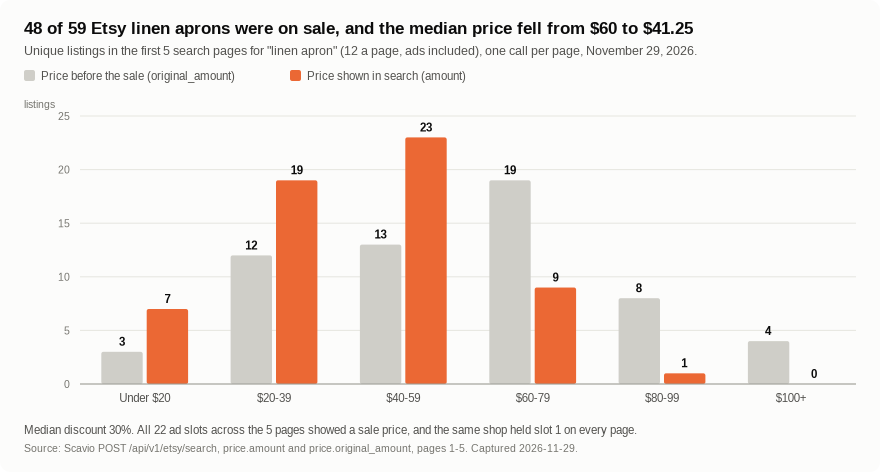
48 of the 59 listings were on sale, at a median discount of 30%. The median price shown in search was $41.25; the median price before those discounts was $60. The 11 listings at full price had a median of $55, so a seller pricing a new apron against "what aprons sell for" gets a different answer depending on which number they read. Ads change the picture too: 22 of the 60 slots were ads, every one of them showed a sale price, and one shop held the first slot on all five pages as an ad. Each row carries price.amount, price.original_amount, price.discount_pct, price.on_sale and is_ad, so you can separate list price from sale price and organic results from paid ones in a single call.
1. Scavio: prices, sale depth and the shop behind each listing
Scavio's Etsy API is 5 POST endpoints, each 2 credits. Measured on November 29:
- Search: "linen apron" returned 12 listings a page, each with
listing_id, title, URL, image, the price object, shop id and name,rating,review_count,is_adandfree_shipping; the five pages took 3.0 to 10.6 seconds each. Filters formin_price,max_price,free_shippingandon_sale, and four sorts, run before results come back. The card'sratingandreview_countare the shop's, rounded the way Etsy shows them: 16,500 on the card for a shop whose profile said 16,475. - Shop: all 40 shops behind the apron search resolved, with review count, rating, admirers, listing count, opening year, location, sections and a star-seller flag. They ranged from a shop that opened in 2026 with one listing and no reviews yet to one with 26,217 reviews and 1,341 listings.
- Listing detail: one apron returned its description, 14 images, the category path, quantity available (4), ships-from state, variations and the listing's own rating from 56 reviews, with the first four reviews, in 11.3 s.
- Shop listings and reviews: a shop's 21 listings in one call, and its reviews 14 to a page across all listings, each tied to the listing it was about.
What it does not do: search returned 12 listings a page in our test, so a deep niche scan is several calls. Lifetime sales_count came back for 11 of the 40 apron shops and 17 of 21 earring shops we tested; for the rest it was null, so treat review count as the volume signal you can always get. There are no in-cart counts, keyword volumes or sales estimates, and there is no stored price history: you build one by calling on a schedule. The benefit is one key and one JSON format for Etsy alongside eBay, Amazon and Walmart, plus an MCP server for agents. How to get Etsy listings, prices and shop data walks through each call with captured responses.
2. Etsy Open API v3: the official route for approved apps
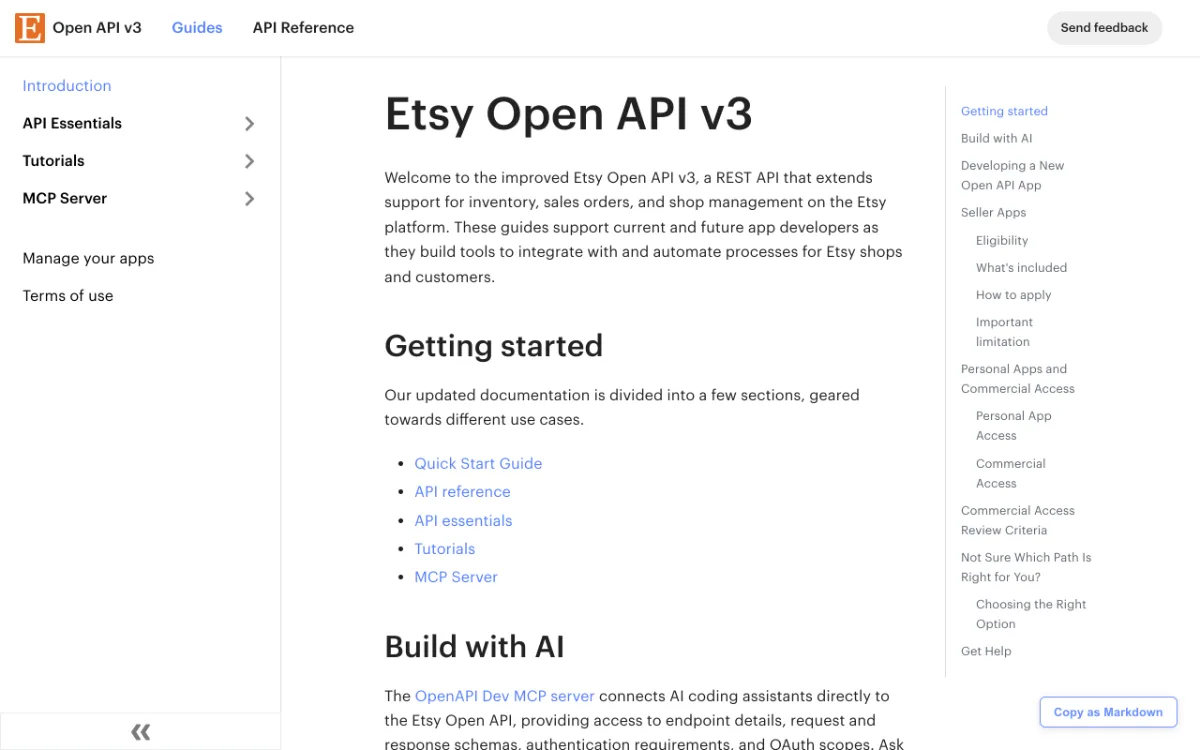
Etsy Open API v3 is free to call once you have an app. Every request needs an x-api-key header built from your keystring and shared secret, and OAuth 2.0 is required on top for private user data and write operations. Etsy lists three paths: a Seller App for your own shop, "approved within minutes"; a Personal App for building beyond your own shop, which gets a deeper review and "limited-scale access based on approved use case"; and Commercial Access, a manual review that requires an approved Personal App first. Rate limits are set per application and shown in the developer portal, and Commercial Access apps must follow the caching policies in Etsy's API Terms of Use. Its reference includes active-listing search with price filters, listing detail, shop lookup and shop reviews, as Microsoft's Etsy connector built on it shows. Choose it if you manage your own shop or your use case passes Etsy's review.
3. Apify actors: scheduled exports, including cart counts
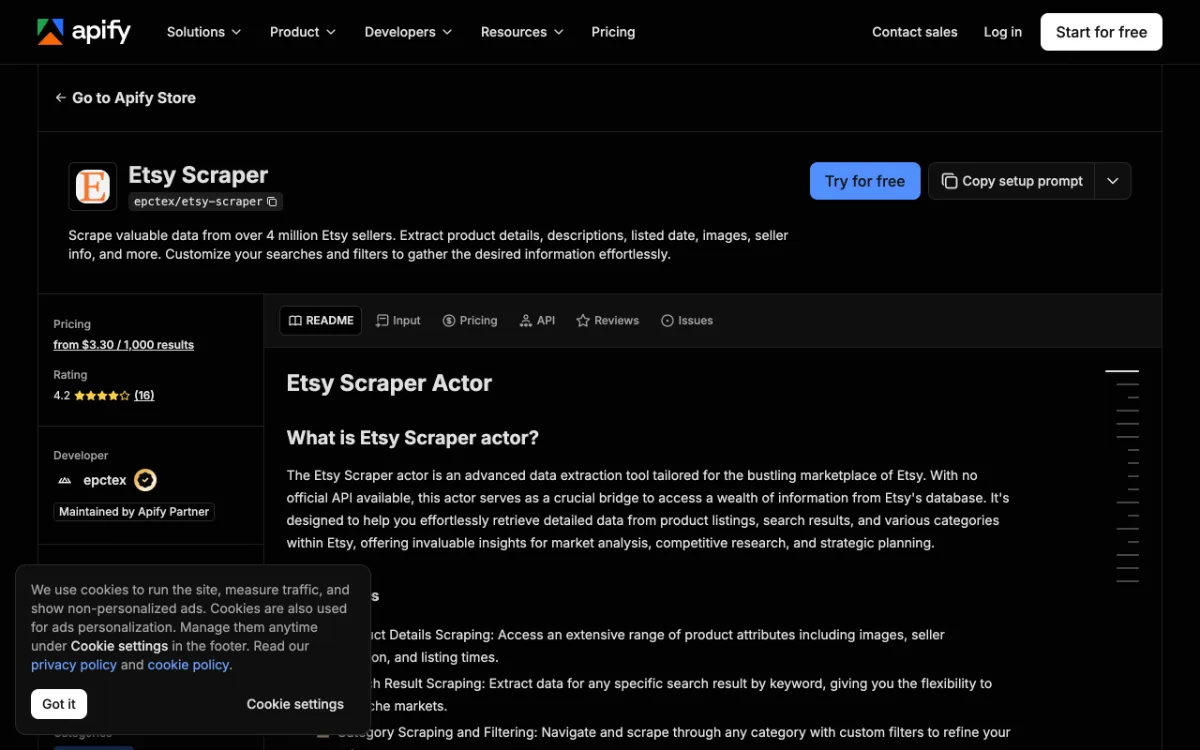
The Apify Store lists many Etsy actors, each maintained by its own author. epctex/etsy-scraper has 5,993 users and a 4.2 rating from 16 reviews, and charges $3.40 per 1,000 results on Apify's free plan, falling to $3.20 on the top tier, plus platform usage. yumitori/etsy-listings-scraper, with 1,952 users, charges $8 per 1,000 listings and advertises live in-cart counts, ad slot positions and bestseller badges, which Scavio does not return. sourabhbgp/etsy-scraper covers search, listings, shops and reviews at $3 per 1,000 rows plus $0.01 a run. Actors run as jobs that write to a dataset, which suits scheduled exports more than a request inside an app; pin the actor you test.
4. Bright Data: Etsy records by the thousand
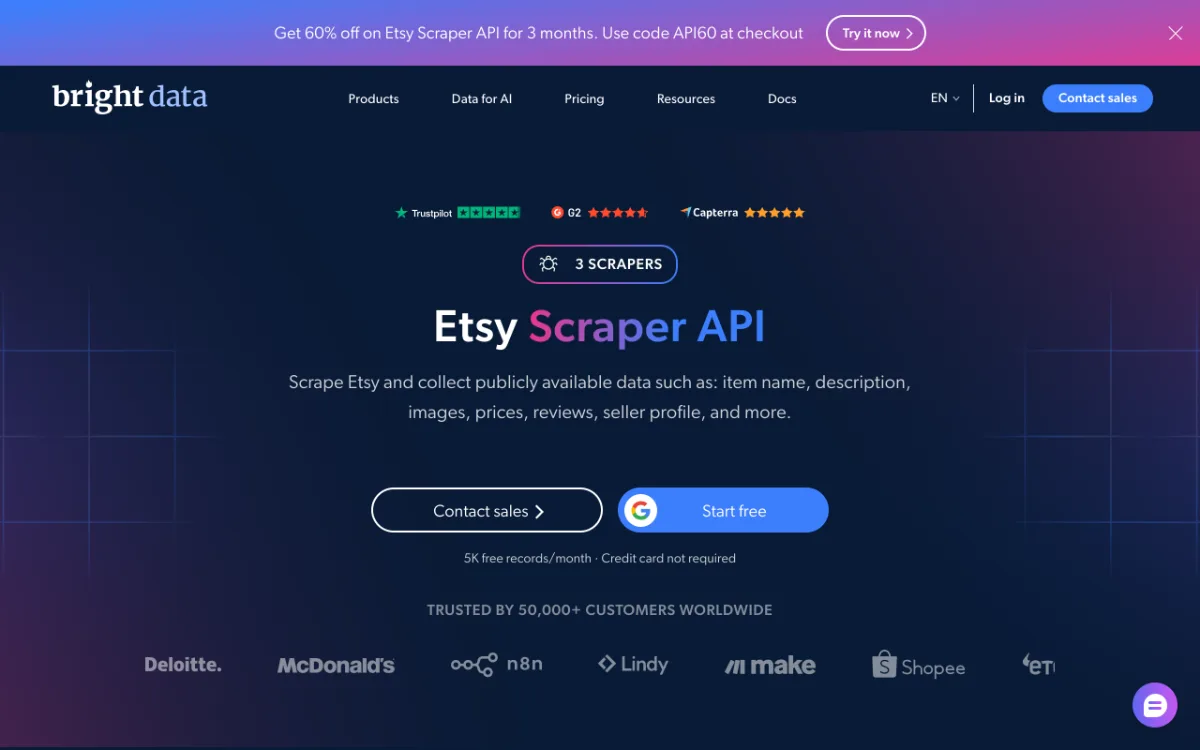
Bright Data's Etsy Scraper API lists three scrapers: by product URL (with an option for all variations), by keyword, and by shop URL, and links a separate Etsy reviews page. It costs $1.50 per 1,000 records pay-as-you-go, or $499 a month for 384,000 records with more at $1.30 per 1,000, and the page offers 5,000 free records a month with no card. Because it bills per record, a keyword run that returns 50 listings is 50 records. Choose it when the deliverable is a large file of listings rather than an answer inside a request.
5. Nextract: an Etsy REST API on prepaid packs
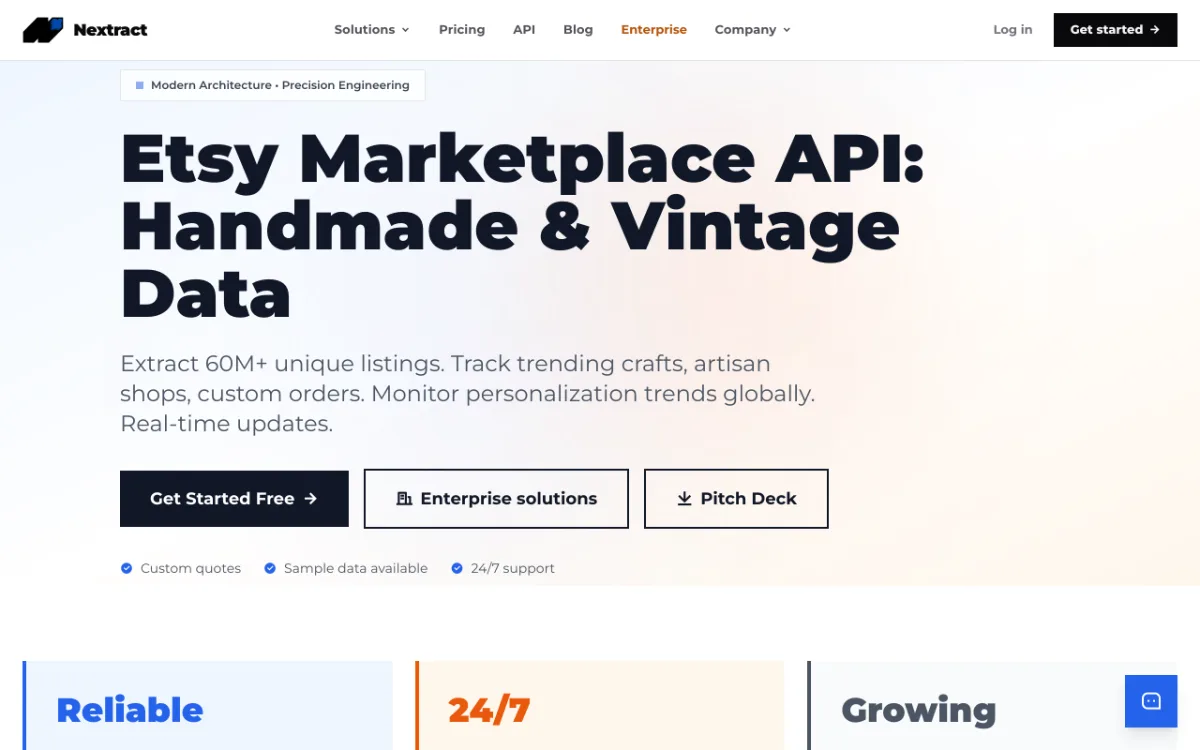
Nextract's Etsy API lists four GET endpoints, for product, reviews, shops and search, and describes product, pricing, review, seller and inventory data without mapping fields to endpoints. Its pricing page sells 28-day prepaid packs in Indian rupees, from ₹249 for 5,000 credits to ₹2,999 for 75,000, says "5 credits per e-commerce product fetch" and offers no trial; it does not state an Etsy-specific cost per call, so ask before you budget. Google's AI Overview cited it for this query on November 29.
6. EverBee: a research app with sales estimates
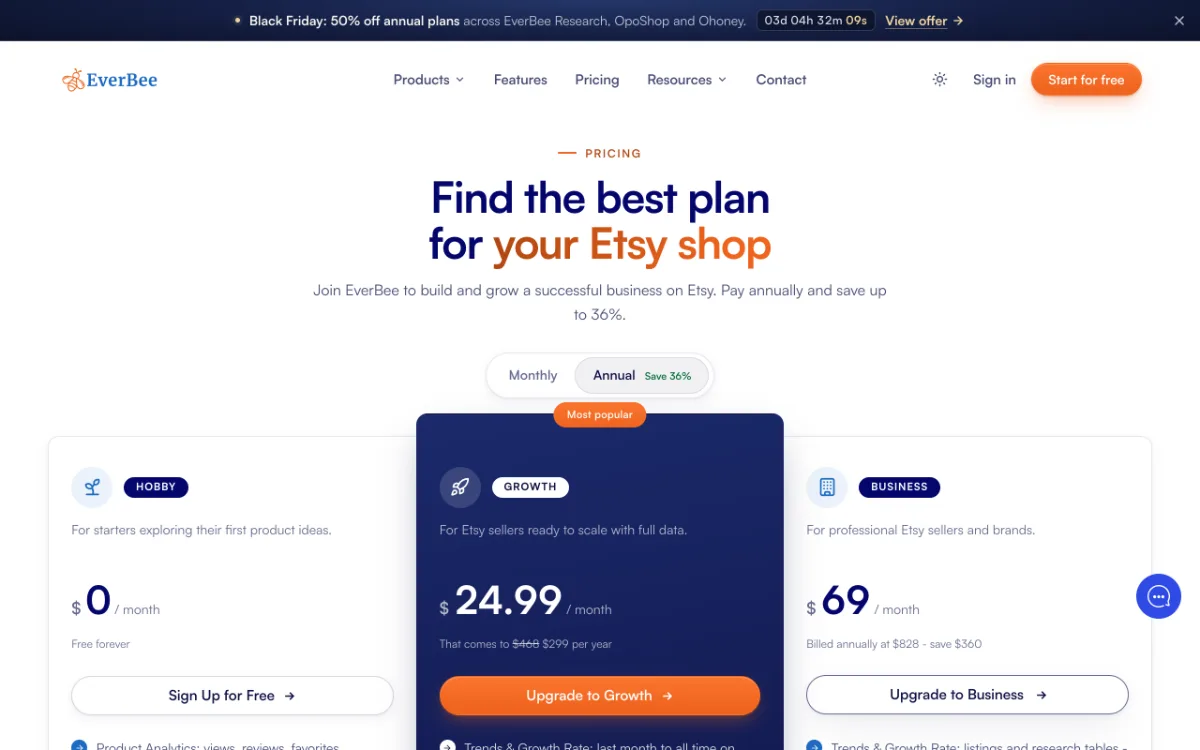
EverBee is an Etsy research app rather than a data API: product analytics for views, reviews and favorites on its free Hobby plan, then sales, revenue and conversion analytics, unlimited keyword research and up to 100 saved shops on Growth at $24.99 a month billed annually ($299 a year), and unlimited saves and 24-month trend patterns on Business at $69 a month billed annually ($828). Its pricing page says its MCP and API are priced per record but publishes no rate there. eRank, a similar research app, runs from free to $29.99 a month (Expert: 500 keyword lookups a day, 200 competitors tracked) and does not mention a developer API. Choose one of these if you want answers in an app rather than data in your own code.
Pick by the number you need
If your product compares Etsy prices, watches a niche or answers "what do shops charge for this", keeping that data current is the ongoing work, and it is what Scavio's Etsy API handles. Tracking 20 keywords five pages deep every day is 100 calls and 200 credits a day, about 6,000 credits a month: $6 at the Growth rate of $1 per 1,000 credits. At 12 listings a page that covers about 1,200 listing prices a day, each with its sale depth; billed per result, the same coverage is about 36,000 results a month. Adding a weekly profile for 40 competitor shops is another 320 credits a month. Try the Etsy API free, 50 credits, no card, or try the endpoints in the playground. No code yet? The free Etsy shop analyzer runs the same endpoints.
Reference: all 5 Etsy endpoints · search docs · how to get Etsy listings, prices and shop data · are cheap Etsy shops making it up in volume?
Frequently asked questions
Does Etsy have a public API for listings and prices?
Yes. Etsy Open API v3 is a REST API that needs a registered app: every request carries an x-api-key header made of your keystring and shared secret, and OAuth 2.0 is added for private data and write operations. Seller Apps connect to your own shop only. Building beyond your own shop takes a Personal App, which Etsy reviews and allows at a limited scale, and Commercial Access is a further manual review.
Where do I find an Etsy API key?
Register an app in Etsy's developer portal. Registration creates an API keystring and a shared secret, and Open API v3 expects both in the x-api-key header as keystring:shared_secret. A Seller App for your own shop is approved within minutes, according to Etsy's documentation; a Personal App goes through a deeper review.
Can an API show a competitor's Etsy prices and sales?
Prices, yes. Scavio's search and shop listings endpoints return every listing's price, and on sale items the pre-sale price and discount percentage. Its shop endpoint returns the shop's review count, rating, admirers, listing count, opening year and, where the shop page shows it, the lifetime sales count. Per-listing sales are not published by Etsy, so tools such as EverBee show estimates.
Which SEO tool is best for Etsy?
It depends on whether you want an app or data. eRank and EverBee are research apps for sellers, with keyword lookups, competitor tracking and estimated sales inside their own interface; eRank runs from free to $29.99 a month and EverBee from free to $69 a month billed annually. An API such as Scavio's returns the raw listings, prices and shop data for your own spreadsheet, dashboard or agent.
Is it legal to use a third-party Etsy data API?
Third-party APIs such as Scavio fetch the public Etsy page you request at the moment you call and return it as JSON; they do not log in or read private account data. Etsy's Terms of Use and API Terms of Use restrict automated access and set rules for its data, so read them for your use case. This is not legal advice; talk to your own counsel.