

To load Redfin listings into a data pipeline, start with Scavio's Redfin API. POST /api/v1/redfin/search returns up to 350 listings a call with price, price per square foot, beds, baths, days on market, coordinates and the MLS number, so a whole ZIP code comes back in 1 to 3 calls: the 2,177 listings in six ZIPs took 9 calls on October 27, 2026. /property adds a home's dated price history, tax history and Redfin Estimate, and /market returns a ZIP's medians and sale-to-list ratio. Every call is 1 credit, $2 per 1,000 calls on the Growth plan billed yearly.
You need a third-party source because Redfin publishes no listings API. Its Data Center downloads are free, but each row is one region for one time period, so they describe markets rather than homes, and Redfin's Terms of Use govern how its site may be used. Licensed MLS feeds are the other official route, one MLS at a time.
We build Scavio, so read this with that bias in mind. Every Scavio number below comes from live calls we made on October 27, 2026. Every competitor detail was read off the vendor's own page that day, and where a detail was not published we say so. The screenshots are each vendor's own Redfin page, captured the same day.
Which Redfin API fits your job?
| Tool | Choose it for | What one billing unit returns | Property detail | Price (checked Oct 27, 2026) |
|---|---|---|---|---|
| Scavio | Scheduled pipelines that need every listing in a ZIP, plus history, sold homes and market stats | Up to 350 listings per search call | One call: price and tax history, Redfin Estimate, schools, climate risk | From $2 per 1,000 calls (Growth, yearly); 50 free credits |
| Unofficial Redfin on RapidAPI | Small apps already billed through RapidAPI | One request to any endpoint | Split across separate endpoints (main info, estimate, amenities, walk score, flood) | Free for 500 requests a month; $20 for 10,000; $300 for 500,000 |
| Apify Redfin Search Scraper | No-code exports of large map searches | Billed per listing | Search only; detail needs another actor | $0.40 to $0.50 per 1,000 listings plus a start fee |
| HasData | Searching by city name or full address | One request, from 10 credits | Separate property endpoint with price and tax history | $49/mo for 20,000 requests (yearly); 100 free |
| Bright Data | Teams that want to own a custom scraper | Billed per page load | Whatever fields you ask its builder for | $1.50 per 1,000 page loads; 5,000 free a month |
| Redfin Data Center | Free region-level market history | One region per period | None | Free |
The first page is not the market
A pipeline that reads Redfin has to answer three questions the docs rarely mention: how many listings a ZIP really holds, whether the first page is representative, and what to do when a field is empty. We pulled every active for-sale listing in six ZIP codes with Scavio's search, paging until a page came back short of the 350 limit.

In downtown Miami (33131), 540 of the 895 listings, 60%, had been for sale 90 days or more. Downtown Austin (78701) was close behind at 124 of 231, then downtown Columbus at 62 of 154 and Scottsdale's 85251 at 158 of 491. The first page hides this. Page 1 of the Miami pull had a median of 40 days on market, page 2 had 161 and page 3 had 427, and the median across all 895 listings was 131. Two more traps: the medians block in each response covers that page only, so compute market medians after you merge the pages, and Redfin shows no days-on-market value for 233 of the 254 listings in Seattle's 98103 and 75 of the 152 in Chicago's Lincoln Park. For those, the dated "Listed" event in the property call's price history is the fallback.
1. Scavio: whole ZIPs, price history, sold homes and market stats
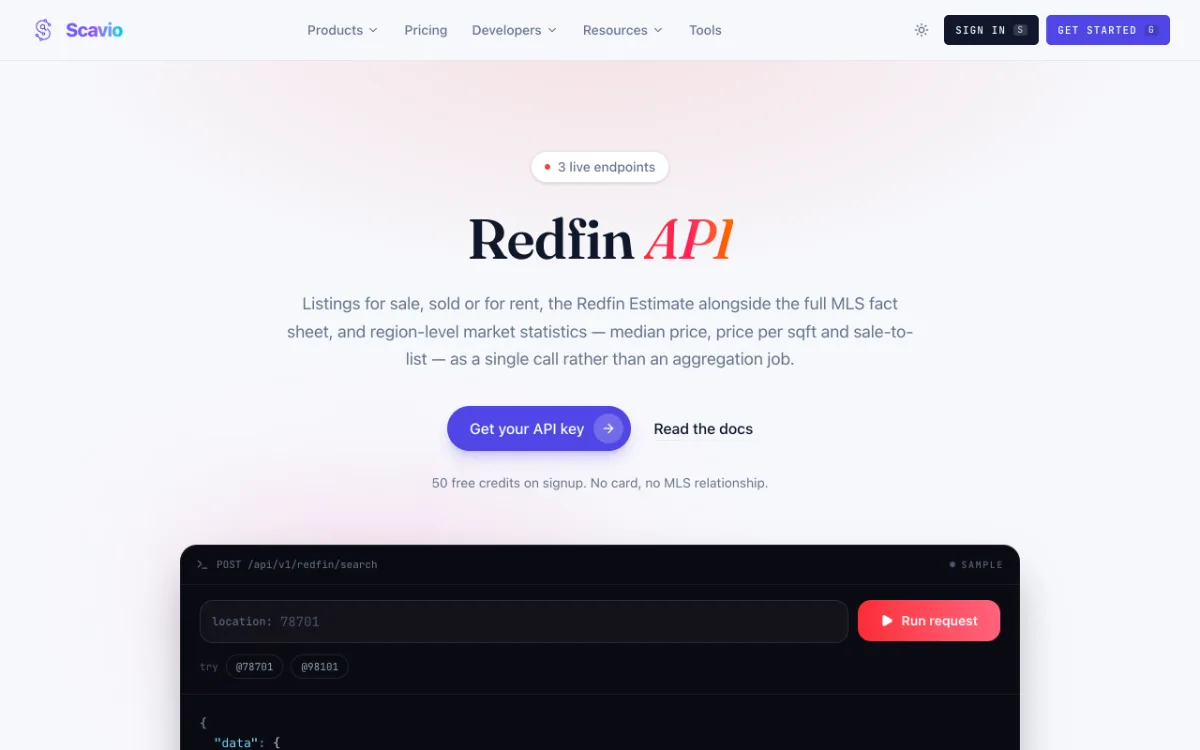
Scavio's Redfin API is 3 POST endpoints at 1 credit each. Measured on October 27:
- Search: up to 350 listings a page for sale, sold or for rent. Seattle's 98103 returned all 254 listings in 5.4 s and downtown Columbus all 154 in 2.9 s; downtown Miami took 3 pages for 895. Each row carries Redfin's property and listing ids, the MLS number, price, price per square foot, HOA, beds, baths, square feet, year built, type, address, coordinates, days on market, the listed date, badges and photos.
sort: "newest"withmax_days_on_market: 7returned downtown Miami's 35 newest listings, none older than 8 days, in one call. - Property: 1812 West Ave #404 in Austin came back in 1.9 s with its price history (listed at $595,000 on September 9, cut to $590,000 on September 19, under contract September 30, sold October 16), 17 years of tax history, a Redfin Estimate of $544,396, a rental estimate of $3,343 a month, three schools, flood, fire and heat risk, 6 comparable sales and 18 similar listings.
- Sold homes:
listing_status: "sold"withsold_within_days: 30returned 55 sales in 98103 with sale prices, such as $1,726,100 for 3915 Sunnyside Ave N, listed at $1,690,000. - Market: for 98103, a median sale price of $950,000, a 100.4% median sale-to-list, 13 median days to pending and a competition score of 87, in 1.5 s.
What it does not do: location takes a ZIP or a Redfin region URL, not a city name. Sold rows have no sold date, so dates come from the property call, and in Texas the sold event carried no price. Failed calls are not charged, but a pipeline should still set long timeouts and retry. The benefit is one key and one JSON format for Redfin alongside Zillow and Realtor.com, plus an MCP server for agents. How to get Redfin listing data into a pipeline walks through each call with captured responses.
2. Unofficial Redfin on RapidAPI: many small endpoints
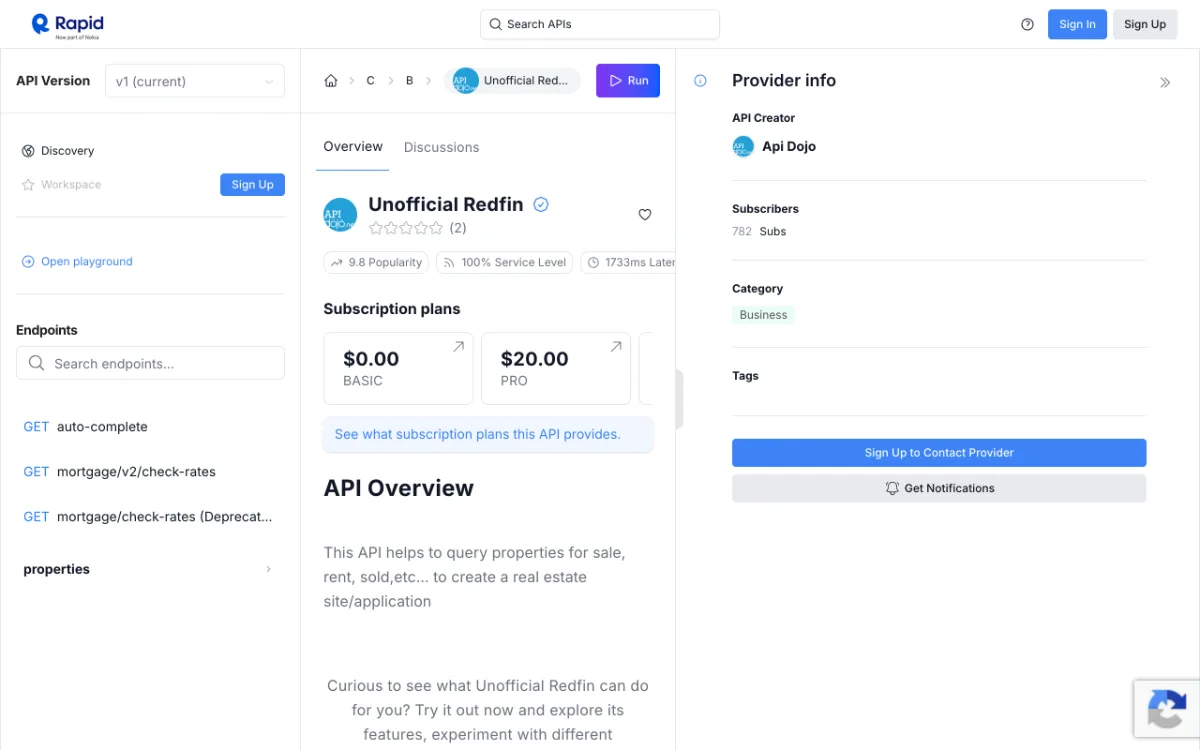
Unofficial Redfin, published by Api Dojo, is the Redfin API most RapidAPI users find: 782 subscribers, a 9.8 popularity score and 1,733 ms average latency on its listing page. It has a properties/list search and splits property detail across separate endpoints, including main info, amenities, estimate, walk score, flood info, agent, tour insights and mortgage calculator, each billed as one request. Plans have hard monthly limits: 500 requests free, $20 for 10,000, $50 for 30,000 and $300 for 500,000 ($0.60 per 1,000). Choose it for a small app that already bills through RapidAPI, and count the requests one home's full detail takes.
3. Apify Redfin Search Scraper: per-listing exports
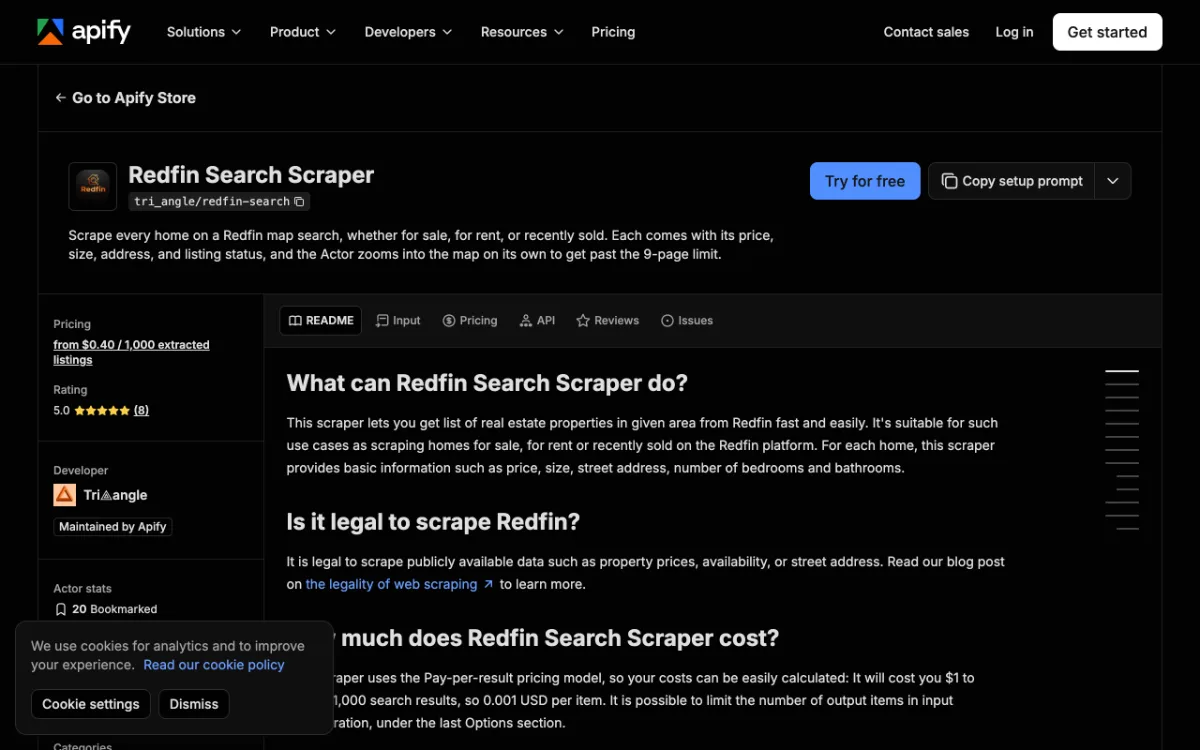
tri_angle/redfin-search, maintained by Apify, has 790 users and a 5.0 rating from 8 reviews. It covers for sale, for rent and recently sold, returns price, size, address, beds, baths, HOA, days on market and the listing agent, and zooms into the map on its own to get past Redfin's 9-page limit. Its pay-per-event pricing is $0.50 per 1,000 listings on Apify's free plan, falling to $0.40 on higher plans, plus $0.0035 a run; the README's own example still says $1 per 1,000. It returns search rows only, so price history or tax history needs a separate detail actor. Choose it for large scheduled exports to a dataset.
4. HasData: search by city name or address
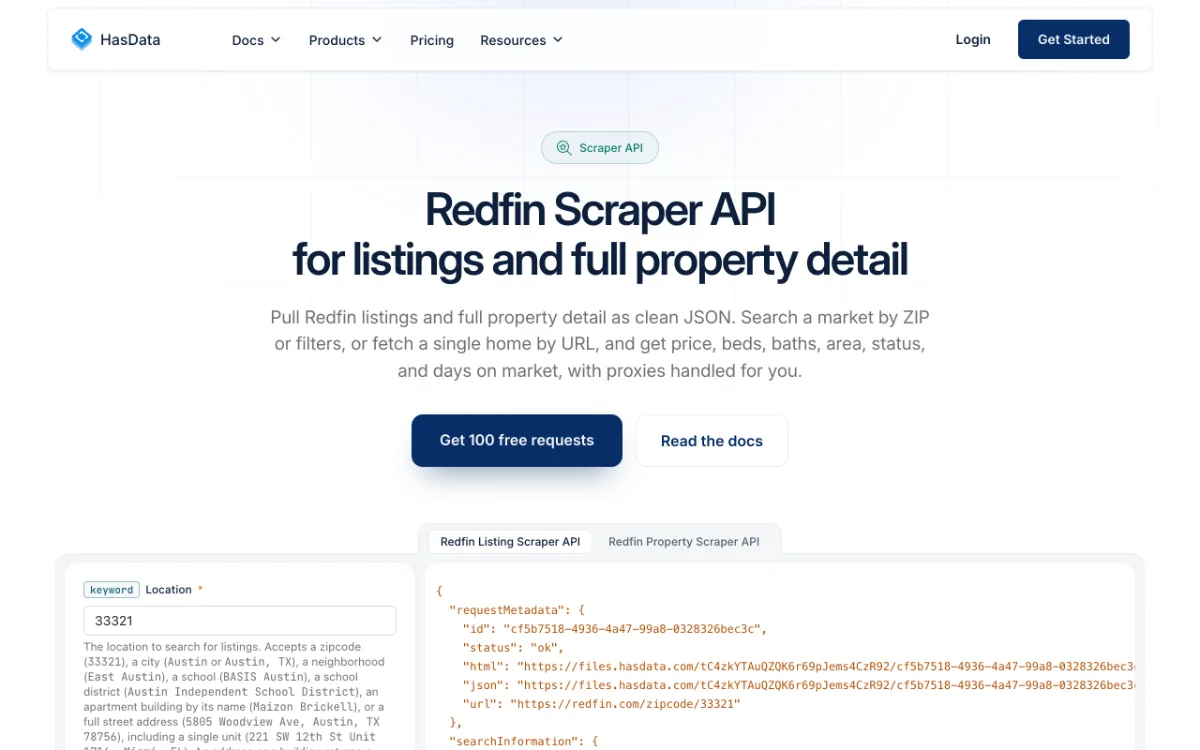
HasData's Redfin API has a listing endpoint and a property endpoint. Its search takes a ZIP, a city such as "Austin, TX", a neighborhood, a school or a full street address, which is more forgiving than Scavio's ZIP-or-URL input, and its property response includes price history, tax history and the Redfin Estimate. Requests start at 10 credits. Plans billed yearly run from $49 a month for 200,000 credits (20,000 requests) to $99 for 100,000 requests and $208 for 300,000, and the free plan gives 1,000 credits, about 100 requests. We did not test how many listings one HasData search request returns.
5. Bright Data: build your own Redfin scraper
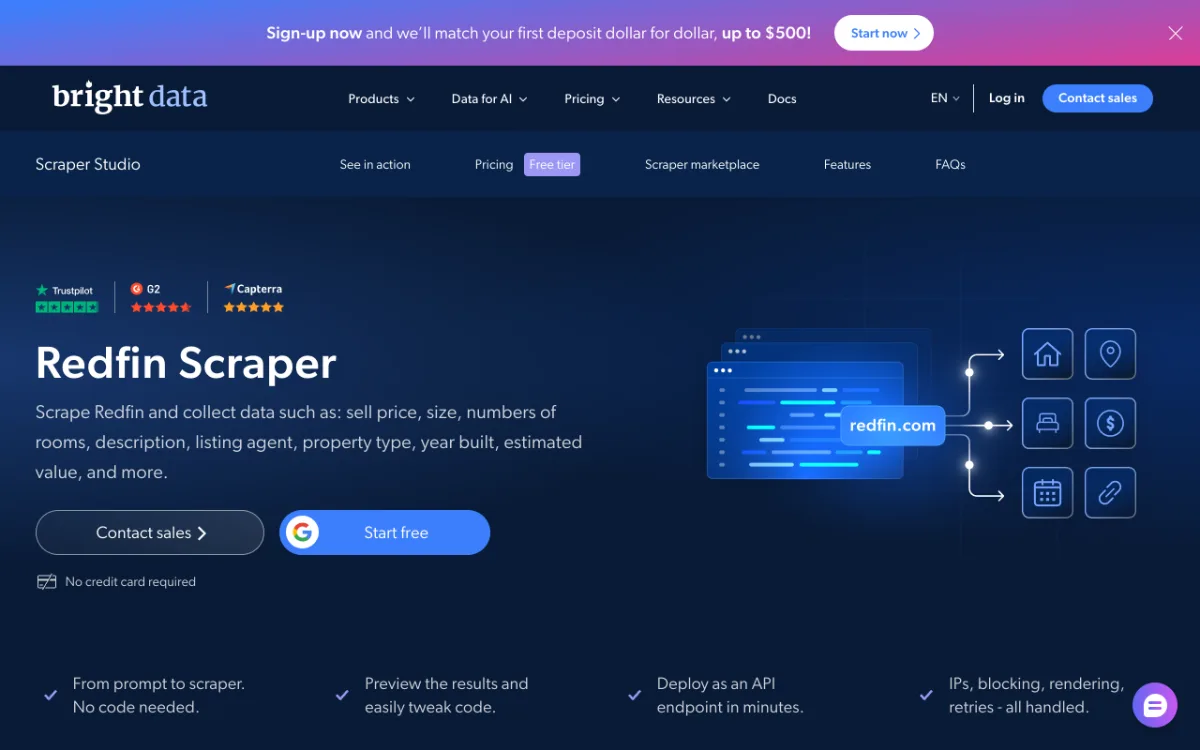
Bright Data's Redfin Scraper is built in its Scraper Studio: you paste a URL and describe the fields, such as sale price, size, rooms, listing agent and estimated value, and its AI generates the scraper, which you can schedule and which it repairs when Redfin changes. Pricing is per page load: $1.50 per 1,000 pay-as-you-go, or $499 a month for 383,000 page loads with more at $1.30 per 1,000, and every account gets 5,000 free page loads a month. It also sells ready-made Redfin datasets. Choose it if you want to own the scraper's logic and output schema.
6. Redfin Data Center: free market history, no listings
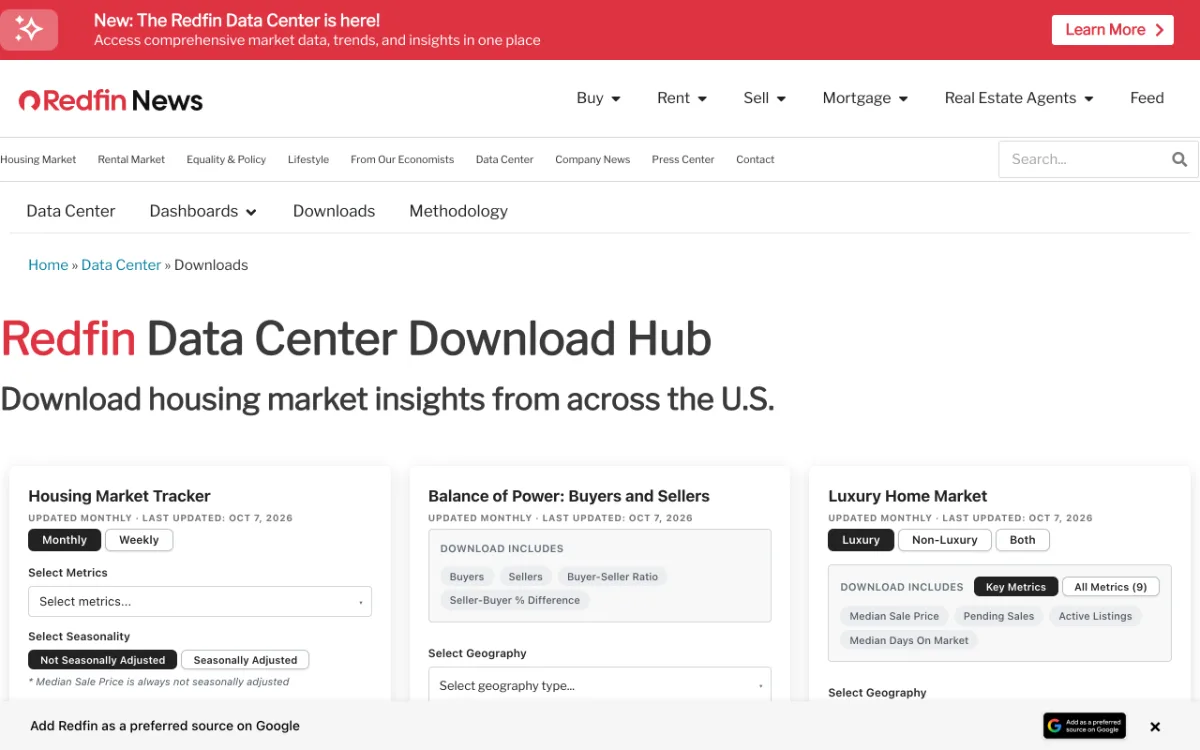
Redfin's Data Center publishes 14 dashboards, among them the Housing Market Tracker (weekly and monthly), price drops, delistings and relistings, and the Redfin Home Price Index, with downloads in which each row is one region for one time period. It is free and is the right source for long market time series. It holds no individual listings, so it cannot tell you which homes are for sale or what one sold for.
Oxylabs also sells a Redfin scraper, and RealtyAPI includes Redfin among its 27 portals; compare what one of their requests returns before you compare prices.
Pick by the number you need
If your pipeline needs every listing in a set of ZIPs, refreshed daily, with the history behind the ones that change, the call count is what decides the cost. Our six ZIPs averaged 1.5 search calls each, so a daily full pull of 50 ZIPs is about 75 calls, or 2,250 credits a month. Adding a property call for each new listing, about 2.5 per ZIP a day at the rate our six ZIPs showed (104 listings on the market 7 days or fewer), is another 3,750. That is about 6,000 credits a month, inside the 7,000 of Scavio's $30 Project plan. Billed per listing at $0.40 to $0.50 per 1,000, the same daily full pulls, about 544,000 listing rows a month, would cost $218 to $272. Try the Redfin API free, 50 credits, no card, or try the endpoints in the playground.
Reference: all 3 Redfin endpoints · search docs · how to get Redfin listing data · sold homes, list vs sale price · best Zillow property data APIs
Frequently asked questions
Does Redfin have a public API?
No. Redfin publishes no developer API for listings. Its Data Center offers free downloads of housing-market data in which each row is one region for one time period, which suits market research but holds no individual listings. For listing-level data you use a third-party API or scraper, or a licensed MLS feed.
Does Redfin get its listings from the MLS?
Yes. Redfin is a brokerage and its for-sale listings come from the multiple listing services it belongs to, which is why every listing carries an MLS number. A property response names its source, such as Unlock MLS in Austin or NWMLS in Seattle, together with that MLS's disclaimer, and MLS rules can limit how you redistribute the data.
What is the cheapest way to get Redfin listing data?
For region-level statistics, Redfin's own Data Center downloads are free. For listings, price per row depends on how many listings one billing unit returns. Scavio's search returns up to 350 listings for 1 credit, so the 2,177 listings in our six test ZIPs cost 9 credits, about 2 cents on the Growth plan billed yearly. Apify's Redfin Search Scraper charges $0.40 to $0.50 per 1,000 listings.
How do I keep Redfin listings current in a pipeline?
Pull each ZIP in full on a schedule and diff by property id: new ids are new listings, missing ids went pending or sold, and a changed price is a price cut or rise. Between full pulls, a search sorted by newest with max_days_on_market picks up fresh listings cheaply, and a property call per changed home adds its dated price history.
Can I get Redfin sold prices through an API?
Yes, where the state discloses them. Scavio's search with listing_status set to sold returned 55 homes sold in Seattle's 98103 in the last 30 days, each with its sale price. In non-disclosure states such as Texas, the sold event in a home's price history can carry no price, so check before you build comps on it.