

For hotel prices inside an app, a rate-parity tool or an AI agent, start with Scavio's Google Hotels API. POST /api/v2/google/hotels returns the properties Google Hotels shows for a destination and stay, each with a lowest nightly price, hotel class, rating and a detail_token; pass that token to /api/v2/google/hotels/detail and you get every booking site's rate for that hotel and those dates, 15 to 39 sites per hotel in our test. Both endpoints cost 1 credit a call, and Scavio starts from $1 per 1,000 requests on the Growth plan.
You need a third-party API because Google does not offer a public one for reading hotel prices. Google Hotel Center and the Travel Partner API are for hotels, chains and travel partners that send Google their own rates: the Travel Partner API manages a partner's account, hotel settings, price views and performance reports behind OAuth2. None of it tells you what Google Hotels shows a traveller for a hotel you do not own.
We build Scavio, so read this with that bias in mind. Every Scavio number below comes from live calls we made on November 29, 2026. Every competitor detail was read off the vendor's own page or documentation that day, and where a detail was not published we say so. The screenshots are each vendor's own Google Hotels page, captured the same day.
Which Google Hotels API fits your job?
| Tool | Choose it for | Each booking site's rate | Other Google Hotels data | Price (checked Nov 29, 2026) |
|---|---|---|---|---|
| Scavio | Apps and agents that need search plus every site's rate with one key | Detail endpoint: nightly rate, stay total and sponsored flag per site | Search with price, class, rating, review breakdown, amenities and coordinates | From $1 per 1,000 requests (Growth); 1 credit a call; 50 free credits |
| SerpApi | Teams already on SerpApi that want the official-site flag and room rates | Property details: prices and featured_prices with an official flag | Separate Reviews, Photos, Autocomplete and Price Calendar APIs | $25/mo for 1,000 searches, $150 for 15,000; 250 free a month |
| SearchApi | Pre-tax and after-tax prices per site | Property API: featured_offers and all_offers with price_before_taxes | Price Calendar API | $40/mo for 10,000 requests, $100 for 35,000; 100 free requests |
| DataForSEO | Large queued batches where minutes of delay are fine | Hotel Info: prices.items with official_site and is_paid | Hotel Searches by SERP of up to 18 hotels | $0.80 per 1,000 hotels (45-min queue) to $4.00 (live); $50 minimum top-up |
| Apify actor (kestrel) | Scheduled exports and date sweeps without code | One offer row per site, official: true on the hotel's site | Details, photos and price calendar as options | $4.00 per 1,000 hotel rows plus $2.00 per 1,000 booking-site rows |
One hotel's price depends on who you ask
Google Hotels does not have one price for a hotel. It lists a rate from every booking site that sells the room, and the headline price on the search page is just the lowest of them. We searched "New York hotels" for one night, check-in Tuesday, December 15, 2026, then made one detail call for each of the 18 properties returned.
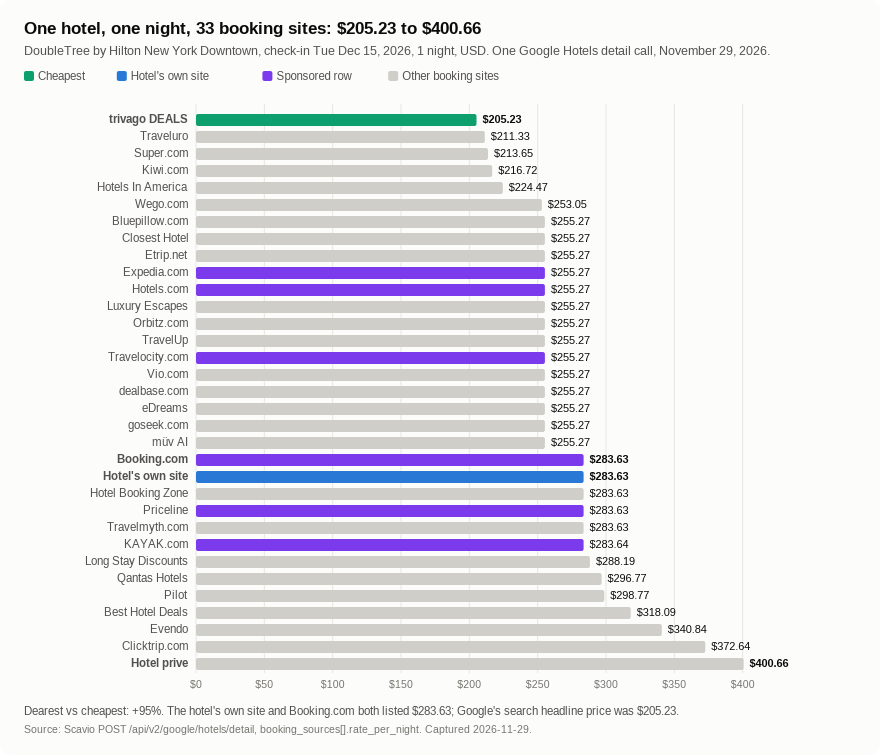
DoubleTree by Hilton New York Downtown came back with 33 booking sites, from $205.23 on trivago DEALS to $400.66 on Hotel prive, 95% more for the same night. Fourteen sites, Expedia, Hotels.com and Orbitz among them, sat at $255.27; the hotel's own site, Booking.com and Priceline all listed $283.63, 38% above the cheapest row.
Across all 18 hotels, the detail calls returned 509 rates, 15 to 39 per hotel with a median of 28. The dearest site's rate was a median 84% above the cheapest. Where the hotel's own site appeared, on 14 hotels, it was the cheapest on one (King Hotel Brooklyn Sunset Park, $94.05). Booking.com appeared on 15 and was the cheapest on none. The first rows of every response carried sponsored: true, and a sponsored row held the lowest rate on 5 of the 18 hotels. The search page's headline price matched the cheapest detail row on 17 of the 18; the exception was The Baltic Hotel, shown at $106.89 in search while Agoda listed $85.03 in detail.
One caution: a site's row is that site's rate for the stay, and the response does not say which room or cancellation policy it prices. The largest gap in our set, 31 Street Broadway Hotel at $69.50 on Vio.com and $896.28 on Kiwi.com, is more likely a different room than a real 12x markup. Compare like for like before you call something a parity breach.
1. Scavio: search plus every booking site's rate with one key
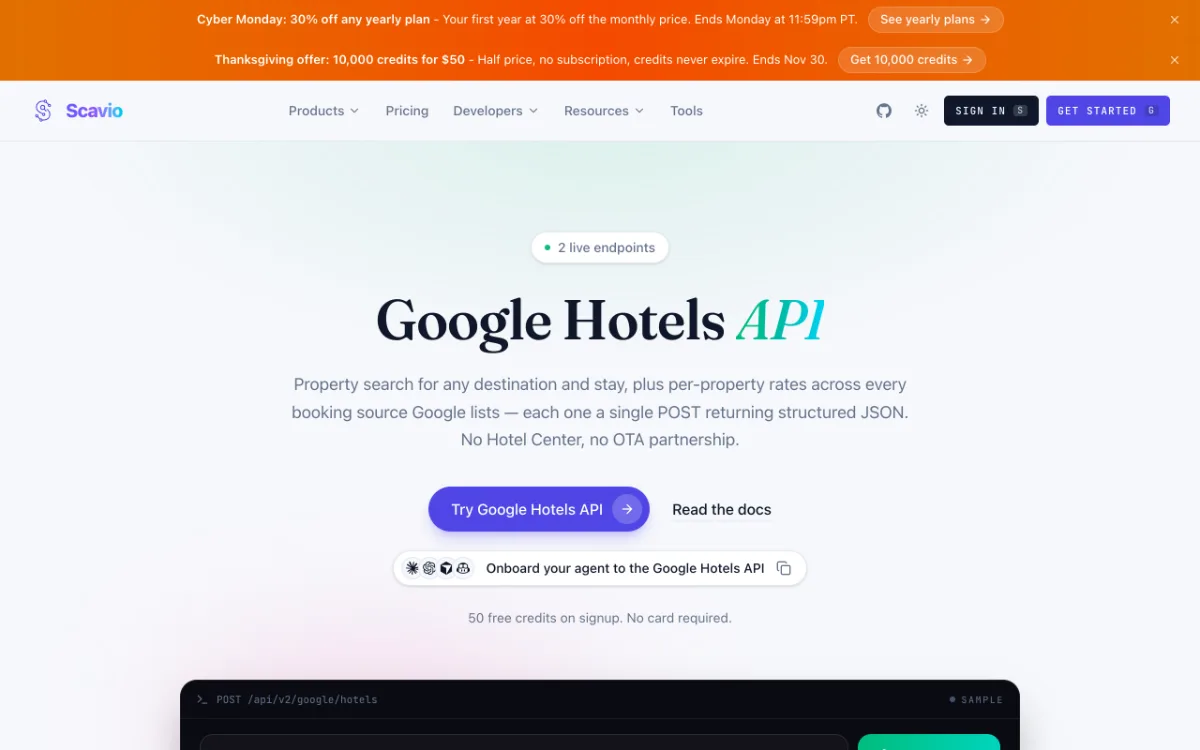
Scavio's Google Hotels API is 2 POST endpoints, each 1 credit. Measured on November 29:
- Search: "New York hotels" for one night returned 18 properties in 4.5 s, each with
price,hotel_class,overall_rating, review count, the 1-5 star split, areviews_breakdownby topic (DoubleTree Downtown: 782 mentions of accessibility, 877 of service), amenity ids, check-in and check-out times, coordinates, nearby places and thedetail_token. Stays longer than a night addtotal_rate. Filters coversort_by, price range,rating,hotel_class, amenities, property type and free cancellation, andnext_page_tokenpages on. - Detail: the token plus stay dates returns
property.booking_sources, one row per site withname,rate_per_night,total_rate,sponsoredand aclicklink. The 18 detail calls took 1.3 to 1.9 s of server time each. A token from the one-night search also priced a two-night stay at the same hotel: 28 sites, from $220.04 a night on Traveluro.
What it does not do: there is no guest-count parameter, so prices are for Google's default occupancy. The detail rows carry no room name, cancellation terms or flag for the hotel's own site, and the detail response does not repeat the hotel's name, so keep it from the search row. A query such as "New York hotels" also returns properties in New Jersey and near the airports, and the lowest-price sort is approximate. There are no review-text, photo or price-calendar endpoints. The benefit is one key and one JSON format for Google Hotels alongside Google Flights, Booking.com, Expedia and Airbnb, plus an MCP server for agents. How to get Google Hotels prices from every booking site walks through each call with captured responses.
2. SerpApi: property details with the official-site flag
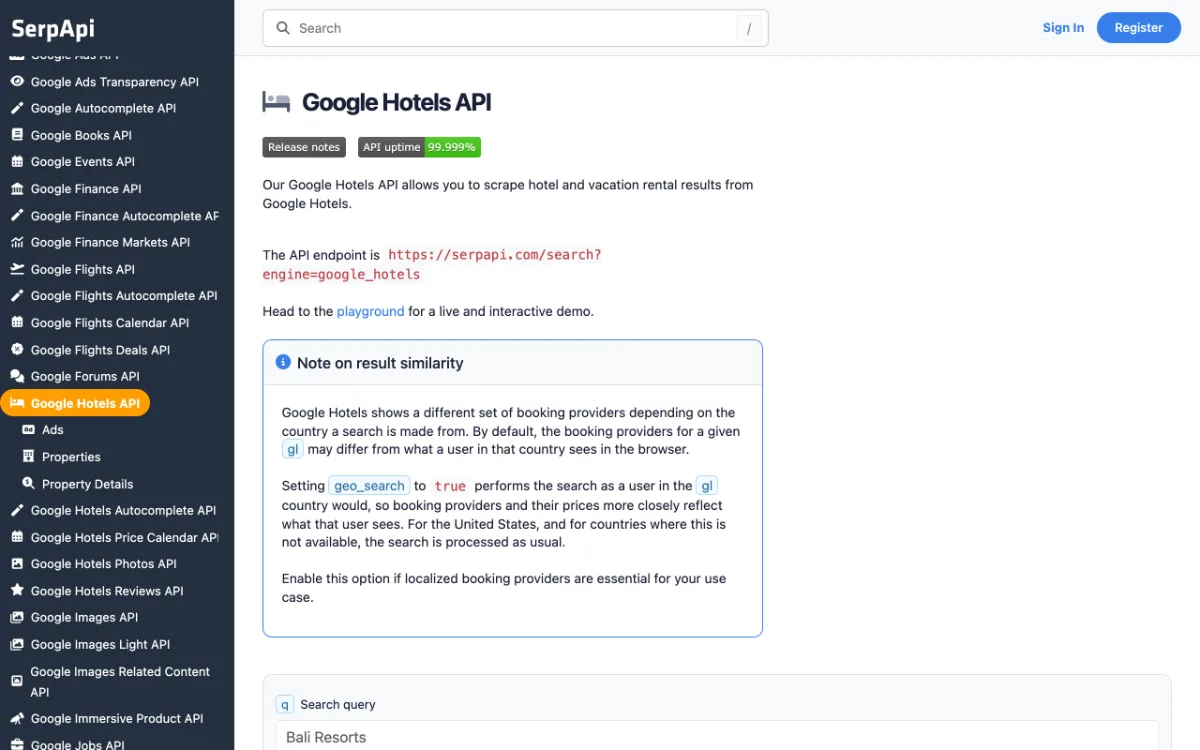
SerpApi's Google Hotels API searches hotels and vacation rentals, and passing a property_token to the same engine returns property details: featured_prices and prices arrays with source, rate_per_night, total_rate and an official flag for the hotel's own site, with room-level rates on featured entries. A geo_search option makes the providers match what a user in the gl country sees, and separate Reviews, Photos, Autocomplete and Price Calendar APIs cover the rest. Pricing is per successful search: 250 free a month, $25 for 1,000, $75 for 5,000 and $150 for 15,000 ($10 per 1,000), with cached searches free. Choose it if your team already uses SerpApi and wants the official flag on every row.
3. SearchApi: offers with pre-tax prices
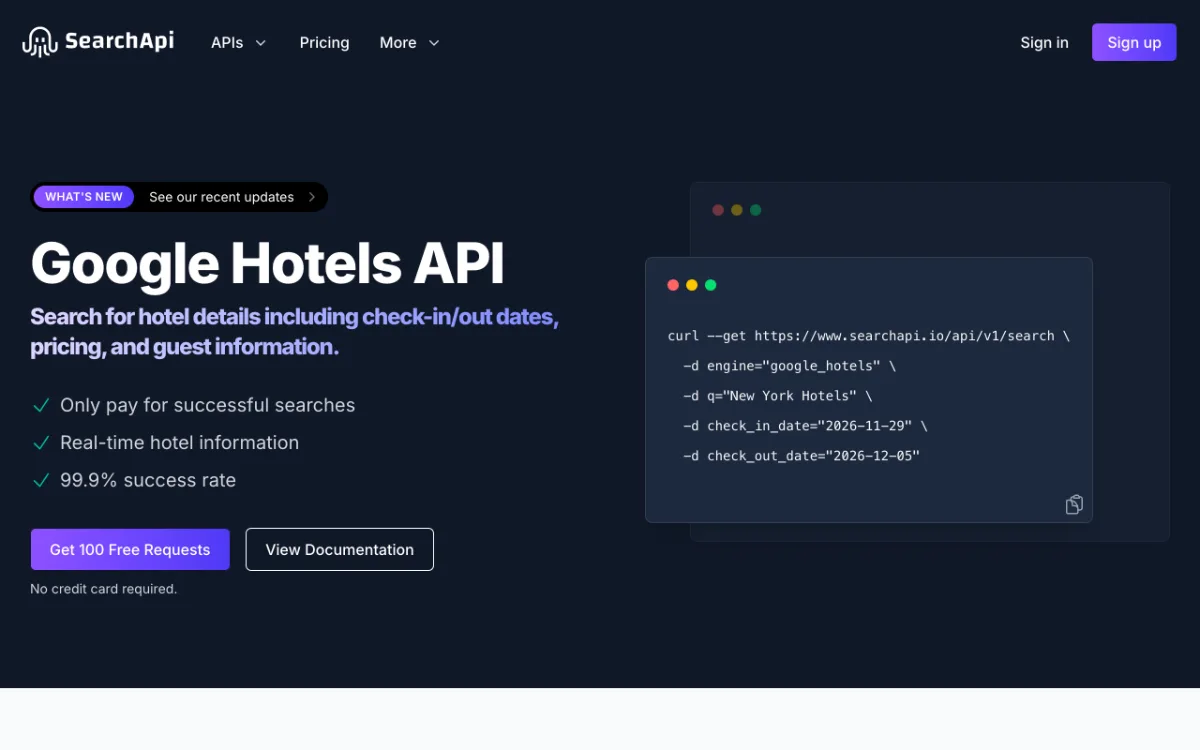
SearchApi's Google Hotels API searches by destination and dates, and its Property API (engine=google_hotels_property) takes a property_token and returns featured_offers and all_offers. Each offer has source, links, num_guests, has_free_cancellation, and price_per_night and total_price, including price_before_taxes where Google shows it separately. A Price Calendar API shows nightly prices across a date range. Pricing is $40 a month for 10,000 requests, $100 for 35,000 and $250 for 100,000, with 100 free requests on signup; the docs do not say whether a property call counts as one request. Choose it if you need the pre-tax split.
4. DataForSEO: queued batches by the hotel
DataForSEO's Google Hotels API has Hotel Searches, billed per results page of up to 18 hotels, and Hotel Info, billed per hotel, whose prices.items list each site's title, price, url, is_paid, official_site and free_cancellation_until. Check-in and check-out are optional and default to tomorrow and the day after. The price list is $0.0008 per hotel in the standard queue (up to 45 minutes), $0.0016 in the priority queue (about a minute) and $0.004 live (about 11 seconds), and loading prices by dates doubles a Hotel Info task. The minimum top-up is $50, with a $1 trial credit. Choose it for large overnight batches where a queue is acceptable.
5. Apify actor kestrel/google-hotels-prices: scheduled runs and date sweeps
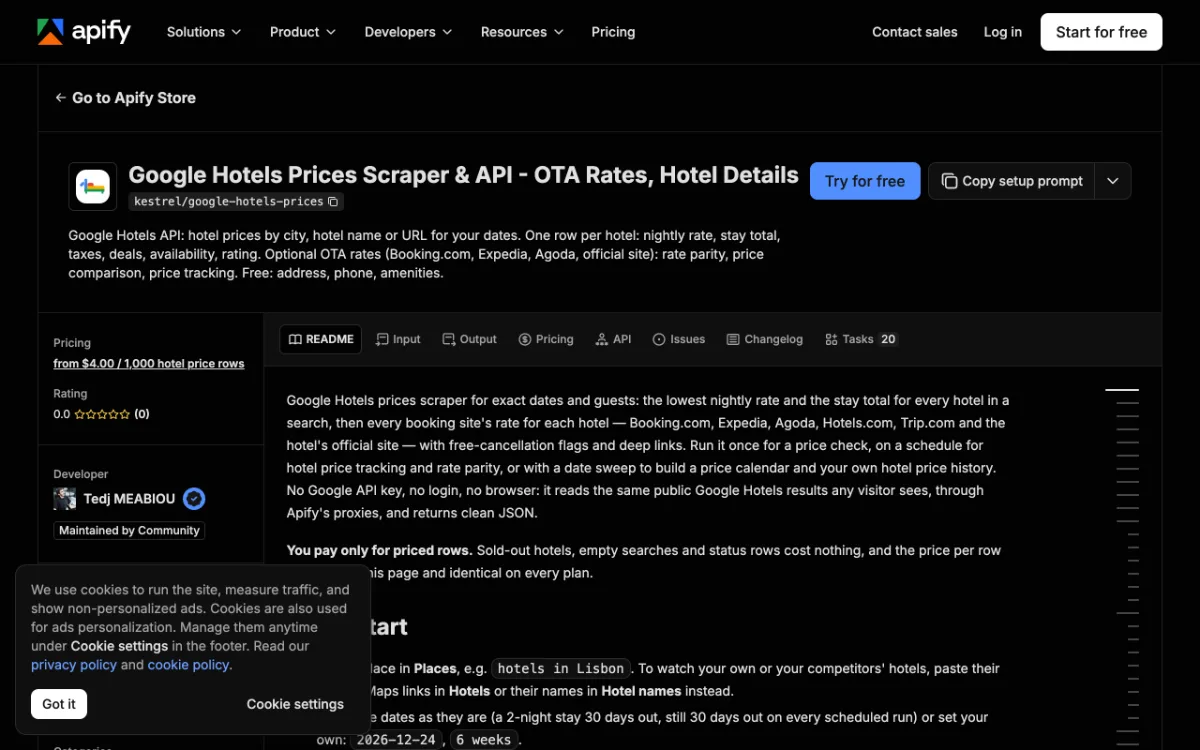
On the Apify Store, kestrel/google-hotels-prices had 354 users on November 29. It takes places or hotel names, dates, adults, children's ages and currency, and with includeOffers on, returns one offer row per booking site with nightly and total prices, cancellation fields and official: true on the hotel's own site; room-level rates are an option. It charges $0.004 per hotel row and $0.002 per booking-site row, so a hotel with 28 sites is about $0.06, with details and photos free and price-calendar nights and reviews extra. Actors run as jobs that write to a dataset, which suits scheduled exports more than a request inside an app. Each actor is maintained by its author, so pin the one you test.
Scrapingdog and others also list a Google Hotels API; check whether their property call returns each booking site's price before you compare.
Pick by the number you need
If your users act on what a hotel costs on each site for specific nights, keeping those rates current is the ongoing work, and it is what Scavio's Google Hotels API handles. Rate-checking a comp set of 10 hotels for each of the next 90 nights, once a day, is 900 detail calls: 27,000 credits a month, about $27 at the Growth rate of $1 per 1,000 credits, and each call returned a median of 28 sites in our test. Watching a whole city instead, one search per check-in date returns up to 20 properties with their lowest price, so 90 dates a day is 2,700 credits a month, about $2.70. Try the Google Hotels API free, 50 credits, no card, or try both endpoints in the playground.
For rates and rate plans read straight from one site, see the best Booking.com hotel price APIs.
Reference: both Google Hotels endpoints · search docs · detail docs · how to get Google Hotels prices by booking site
Frequently asked questions
Does Google Hotels have a public API for hotel prices?
No. Google's Hotel Center and Travel Partner API serve hotels, chains and travel partners that send Google their own rates: the Travel Partner API manages a partner's account, hotel settings, price views and performance reports behind OAuth2. Neither lets a developer read what Google Hotels shows for any hotel. For that you need a third-party API such as Scavio's Google Hotels API.
Can I get every booking site's price for one hotel through an API?
Yes. Scavio's /api/v2/google/hotels/detail takes a property's detail_token from a search plus your stay dates and returns booking_sources, one row per site with its nightly rate, stay total and a sponsored flag. On November 29, 2026 that was 15 to 39 sites per hotel across 18 New York hotels. SerpApi, SearchApi, DataForSEO and Apify actors also return per-site prices.
Why do booking sites show different prices for the same hotel?
Each site lists its own rate for the stay: some show member or package deals, some a different room or cancellation policy, and some sites pay to be listed first. Across 18 New York hotels for one night on December 15, 2026, the dearest site's rate was a median 84% above the cheapest. The hotel's own site was the cheapest on 1 of the 14 hotels where it appeared.
How much does a Google Hotels API cost?
On November 29, 2026: Scavio is 1 credit a call, $1 per 1,000 calls on its Growth plan, with 50 free credits. SerpApi is $25 a month for 1,000 searches and $150 for 15,000. SearchApi is $40 a month for 10,000 requests. DataForSEO's Hotel Info is $0.80 to $4.00 per 1,000 hotels depending on queue speed. The Apify actor kestrel/google-hotels-prices is $4.00 per 1,000 hotel rows plus $2.00 per 1,000 booking-site rows.
Is it allowed to use a Google Hotels API?
Third-party Google Hotels APIs fetch the public results page when you ask and return what it shows as JSON; they do not log in as a user. You remain responsible for how you use the data, including Google's terms of service and the terms of the booking sites whose rates appear. This is not legal advice; check your own use case with counsel.