
Kalodata launched its Open API in 2026, but access still requires the Enterprise plan at $570 or more per month. Scavio's /api/v1/tiktok-shop/search returns the same live product data at 1 credit per call, key issued at signup, no sales call.
If you searched for "kalodata api" hoping to find a signup page, that is why you did not find one. The API exists, it launched, and it covers six modules. Getting access requires contacting sales and committing to Enterprise pricing that starts well above what most TikTok Shop builders need to spend.
What changed in 2026
Kalodata announced the Open API publicly. Before that, the endpoint list circulated only in partner-facing material. The launch added official documentation and a formal application process, but it did not change the access tier. API access remains Enterprise-only.
Here is what the landscape looks like now:
- Kalodata dashboard (Starter $36-50/mo, Professional $84-130/mo): analytics UI, trend charts, creator discovery, CSV export. No API.
- Kalodata Open API (Enterprise $570+/mo): six modules (Category, Shop, Creator, Product, Video, Livestream), ranking and detail endpoints, requires application.
- Scavio TikTok Shop API ($30/mo for 7,000 credits): 8 endpoints, raw JSON, key at signup, 1 credit per call.
The 8 TikTok Shop endpoints you can call now
Every endpoint costs 1 credit. No application, no annual contract, no sales call.
/tiktok-shop/search-- product search across TikTok Shop/tiktok-shop/search/suggestions-- query autocomplete/tiktok-shop/product-- full product detail by ID/tiktok-shop/product/reviews-- paginated reviews for a product/tiktok-shop/categories-- the category tree/tiktok-shop/category/products-- products within a category/tiktok-shop/shop/products-- a seller's catalogue/tiktok-shop/resolve-- turn a share link into a product ID
What a real response looks like
This is a live captured response from /tiktok-shop/search for "pet grooming", not a mock:
{
  "product_id": "1731078511844299591",
  "title": "oneisall 7 in 1 Pet Grooming Kit & Vacuum",
  "price": {
    "current": 25,
    "currency": "USD",
    "min": 25,
    "max": 25
  },
  "rating": { "score": 0, "review_count": 0 },
  "sold_count": 36,
  "variant_count": 4,
  "shop": {
    "shop_id": "7496107478898805575",
    "shop_name": "Cassy Collins"
  },
  "labels": []
}
One credit, one call, raw JSON. The product ID chains into /tiktok-shop/product for full detail and /tiktok-shop/product/reviews for buyer feedback.
What Kalodata gives you that the API does not
Kalodata's moat is the historical archive. Their dashboard stores up to 500 days of product performance data that you cannot replicate without collecting it yourself starting today. If you need to answer "how did this product's sales rank change over the last 6 months," Kalodata has that and Scavio does not.
Kalodata also provides:
- Pre-built visualizations and trend charts
- 100M+ product database with categorization
- Creator discovery with engagement scoring
- Trending product alerts
- Point-and-click interface, no code required
- CSV export for spreadsheet workflows
What the API gives you that Kalodata does not
- Automation. A cron job that checks 50 products every morning costs 50 credits ($0.25) and runs unattended. In Kalodata's dashboard, that is 50 manual searches.
- Integration. JSON responses feed directly into your inventory system, ad platform, or AI agent. No CSV download, no manual import.
- Custom scoring. You weight the metrics however you want rather than accepting Kalodata's default ranking.
- Real-time data. Every call hits TikTok Shop live. Kalodata's dashboard shows cached snapshots that update on their schedule, not yours.
- MCP server. Scavio's MCP server exposes TikTok Shop as tools inside Claude Desktop, Claude Code and any MCP-compatible client. No official Kalodata MCP server exists.
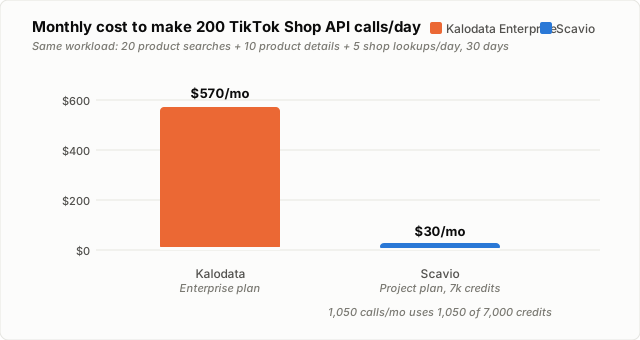
Cost comparison at realistic usage
A dropshipper researching products daily:
# 20 product searches + 10 detail lookups + 5 shop checks = 35 calls/day
daily_calls = 35
monthly_calls = daily_calls * 30  # 1,050

kalodata_enterprise = 570   # minimum Enterprise tier
scavio_project      = 30    # 7,000 credits included

scavio_credits_used = monthly_calls  # 1,050 of 7,000
scavio_per_call     = scavio_project / 7000  # $0.0043

# Kalodata: $570 for dashboard + API
# Scavio:   $30 for 7,000 credits, 1,050 used, 5,950 left over
# Savings:  $540/month
At 35 calls per day you use 1,050 of your 7,000 monthly credits. The remaining 5,950 credits work across every other Scavio endpoint -- Amazon, Instagram, YouTube, Reddit, Google and 40 more platforms.
Building what Kalodata shows, with the API
The historical archive is Kalodata's real advantage. But if you start collecting today, you build your own:
import requests, sqlite3, os
from datetime import date

def track_products(queries: list[str]):
    """Daily product tracker -- run via cron, builds history over time."""
    headers = {"Authorization": f"Bearer {os.environ['SCAVIO_API_KEY']}"}
    conn = sqlite3.connect("tiktok_products.db")
    conn.execute("""
        CREATE TABLE IF NOT EXISTS snapshots (
            id INTEGER PRIMARY KEY,
            query TEXT, product_id TEXT, title TEXT,
            price REAL, sold INTEGER, rating REAL,
            tracked_date TEXT,
            UNIQUE(product_id, tracked_date)
        )
    """)

    for q in queries:
        resp = requests.post(
            "https://api.scavio.dev/api/v1/tiktok-shop/search",
            headers=headers, json={"search": q}, timeout=15,
        )
        for p in resp.json().get("data", {}).get("products", []):
            try:
                conn.execute(
                    "INSERT INTO snapshots VALUES (NULL,?,?,?,?,?,?,?)",
                    (q, p["product_id"], p["title"],
                     p["price"]["current"], p.get("sold_count", 0),
                     p.get("rating", {}).get("score", 0),
                     str(date.today())),
                )
            except sqlite3.IntegrityError:
                pass
    conn.commit()
    return conn.execute("SELECT COUNT(*) FROM snapshots").fetchone()[0]

# 10 queries/day = 10 credits = $0.05/day
# After 30 days: 30 snapshots per product
# After 500 days: you match Kalodata's depth
The tradeoff is real: 500 days of data takes 500 days to build. If you need historical analysis right now, pay for Kalodata. If you need live automation going forward, the API is cheaper and more flexible. Many operators use both: Kalodata for historical research, API for automated monitoring.
When Kalodata wins
You are a non-technical dropshipper or brand manager who needs to browse trending products, filter by category and export spreadsheets. You value the 500-day historical database. You want trend visualizations without writing code. You need creator discovery with engagement scoring already calculated. You do not mind paying $570+ per month for API access on top of dashboard features.
When the API wins
You are building automated product research pipelines. You need real-time data that feeds directly into your systems. You want to integrate TikTok Shop with your inventory, ad platform or AI agents. You need custom scoring models. You want one API key that covers TikTok Shop and 45 other platforms. You want to start calling endpoints in five minutes rather than waiting for a sales conversation.
Try it before you decide
Scavio's TikTok Shop endpoints are live now. Signup takes under a minute, the key is issued immediately, and the free tier includes 50 credits -- enough to run the product search above and check every field yourself.
Start with 50 free credits -- no card required.
The docs are at scavio.dev/docs, and the playground lets you run every endpoint in the browser before writing code.