
SearchAPI.io returns structured Google results at roughly half the cost of SerpApi, with the same REST interface, but drops fields like People Also Ask and Shopping results often enough that you need to check whether your pipeline uses them. Scavio's /api/v2/google returns the same structured SERP data at $4.29 per 1,000 queries and adds 45 other platforms (Amazon, YouTube, Reddit, TikTok, Instagram, Walmart) on the same API key.
Updated September 2026 with current pricing, a real captured response, and the impact of Google's August 2026 goto rollout on all five providers.
What the numbers actually are
Entry-tier pricing as of September 2026, verified against each provider's public pricing page:
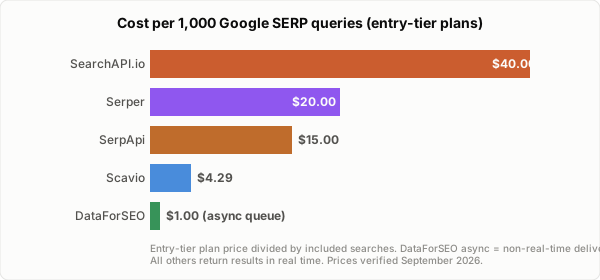
| Provider | Entry plan | Included searches | Cost per 1,000 | Delivery |
|---|---|---|---|---|
| SearchAPI.io | $40/mo | 1,000 | $40.00 | Real-time |
| Serper | $50/mo | 2,500 | $20.00 | Real-time |
| SerpApi | $75/mo | 5,000 | $15.00 | Real-time |
| Scavio | $30/mo | 7,000 | $4.29 | Real-time |
| DataForSEO | ~$1/1k | Pay-as-you-go | ~$1.00 | Async queue |
SearchAPI.io's entry math is unfavorable ($40 for 1,000 queries), but their Production plan at $100/month for 35,000 searches reaches $2.86/1k, which is competitive. The catch is the $100/month commitment to get there. Scavio's $30 plan gives 7,000 credits at $4.29/1k with no volume commitment above that.
DataForSEO is cheapest by far, but uses an async delivery model: you submit a task, poll for results, and receive them minutes to hours later. Every other provider on this list returns results in the HTTP response. If your use case is batch rank tracking on a schedule, DataForSEO's queue is the right tool. If you need results inside an agent loop or a real-time workflow, you need one of the other four.
The field-coverage tradeoff
SearchAPI.io modeled its API on SerpApi, so the interface is nearly identical. The difference is in which SERP features actually populate.
Consistently returned by both:
- Organic results (title, URL, snippet, position)
- Knowledge Graph
- Related Searches
Where SearchAPI.io drops fields:
- People Also Ask: intermittently empty where SerpApi returns 4-8 questions
- Featured Snippets: text field occasionally missing
- Shopping results: inconsistent formatting, missing price fields
- AI Overview: both providers now handle Google's goto tokens differently
For rank tracking (positions and URLs only), the missing fields do not matter and SearchAPI.io saves money. For AI agent grounding or content research where SERP features drive the output, incomplete data means incomplete context.
Real response from Scavio
Captured September 2026. The link field returns the destination URL directly, and related_questions and related_searches are populated on every query that has them.
import requests, os

resp = requests.post(
    "https://api.scavio.dev/api/v2/google",
    headers={
        "Authorization": f"Bearer {os.environ['SCAVIO_API_KEY']}",
        "Content-Type": "application/json",
    },
    json={"query": "best project management tools 2026", "country_code": "us"},
)
data = resp.json()

# Captured response (September 2026):
# response_time: 5994ms
# credits_used: 1
#
# organic_results[0]:
#   position: 2
#   title: "Project management tools ranked + comparison table (2026 update)"
#   link: "https://..."
#   snippet: "Project management tools ranked + comparison table..."
#
# related_questions:
#   - "What are the project management trends for 2026?"
#   - "What are the top 5 project management tools?"
#
# related_searches:
#   - "Top 10 project management tools"
#   - "Best project management tools 2026 reddit"
What the August 2026 goto rollout changed
Google began routing some result links through google.com/goto tokens in August 2026. This affects every SERP API provider identically since they all scrape the same HTML.
Measured across 354 organic results on 40 queries via Scavio: 23 carried goto tokens (6.5%). The other 93.5% remained plain destination URLs. For organic rank tracking, the impact is a rounding error. The real damage is in AI Overview citations, where 334 of 336 links were opaque goto tokens requiring a separate request to resolve.
Any SERP API that pre-resolves goto tokens for you saves you that follow-up work. If your provider does not, you need one additional GET request per goto link to read the 302 redirect. At 6.5% of organic results, that is roughly 1 extra request per 15 organic results.
Decision criteria (updated)
Choose SearchAPI.io if you need a drop-in SerpApi replacement at lower cost and your pipeline only uses organic positions and URLs. The interface is close enough that switching is a find-and-replace on the base URL.
Choose SerpApi if you need maximum SERP field coverage, mature SDKs in 7+ languages, and can afford the premium. SerpApi's lawsuit with Google (settled 2026) tested the legal boundary and the service is still running.
Choose Serper if speed matters more than field depth. Serper is the fastest SERP API in most benchmarks but returns fewer structured features than SerpApi.
Choose DataForSEO if you run batch jobs (scheduled rank tracking, large keyword audits) and do not need results in real time. At $1/1k in the async queue, nothing else is close on price.
Choose Scavio if you need Google SERP data AND data from other platforms under one key. One API key covers Google, Amazon, YouTube, Walmart, Reddit, TikTok, Instagram, LinkedIn, eBay, Facebook, and 35 more. At $4.29/1k on the $30 plan, the Google SERP cost alone is competitive, and the multi-platform access is included rather than billed separately.
Platform coverage comparison
| Platform | SearchAPI.io | SerpApi | Scavio |
|---|---|---|---|
| Google Search | Yes | Yes | Yes |
| YouTube | Yes | Yes | Yes |
| Google Maps | Yes | Yes | Yes |
| Amazon | No | Yes | Yes |
| Walmart | No | No | Yes |
| No | No | Yes | |
| TikTok | No | No | Yes |
| No | No | Yes | |
| No | No | Yes | |
| eBay | No | Yes | Yes |
| No | No | Yes |
SearchAPI.io adds Bing, Baidu, and Google Scholar. SerpApi adds Bing, DuckDuckGo, and Apple Maps. Scavio adds 39 platforms that neither covers, at the cost of not offering Bing or Baidu.
The work SearchAPI.io does not remove
Every SERP API, including Scavio, solves the same core problem: you do not have to run headless browsers, rotate proxies, or parse HTML yourself. What they do not solve is the integration layer: different SDKs per provider, separate billing, separate rate limits, separate key management.
If you only need Google results, that integration cost is zero, any single provider works. The cost appears when you add a second platform. A brand monitoring agent that tracks Google mentions AND Reddit threads AND YouTube comments needs either three providers and three keys, or one provider that covers all three.
Scavio absorbs that integration cost. Token management, proxy rotation, and response normalization happen server-side for all 50 platforms. When a platform changes its markup (or, as Google just did, wraps its links in goto tokens), the fix ships on our side rather than requiring a parser update in your codebase. One credit per call, $30/month for 7,000 credits, no card required on the free tier of 50 credits.
Start with the free tier to check field coverage on your actual queries: dashboard.scavio.dev/sign-up. 50 credits is enough to run 50 Google searches and compare the response against what your current provider returns.