

For Indeed job data inside an app, a job board, a salary benchmark or an AI agent, start with Scavio's Indeed API. One POST to its search endpoint returns a live page of postings in about 3.5 seconds, and every row already carries the salary as numbers (salary_min, salary_max, salary_period), the employer's rating and review count, the job type, benefits and posting date. Job detail, employer profiles and employee reviews sit behind the same key. Every Indeed call is 2 credits, about $4 per 1,000 requests on the Growth plan billed yearly, and 50 free credits come with signup.
You need a third-party API because Indeed no longer offers one for reading postings. Its partner documentation lists the Job Sync API, the Job Update API and a Publisher JavaScript Plugin: tools for ATS partners, agencies and employers to create and manage jobs on Indeed, and for publishers to display Indeed jobs on their own site. None returns search results as data. The old Publisher job search documentation at opensource.indeedeng.io/api-documentation now redirects to Indeed's engineering blog.
We build Scavio, so read this with that bias in mind. Every Scavio number below comes from live calls we made on October 27, 2026. Every competitor detail was read off the vendor's own page that day, and where a detail was not published we say so. The screenshots are each vendor's own Indeed page, captured the same day.
Which Indeed API fits your job?
| Tool | Choose it for | Salary | How you get data | Price (checked Oct 27, 2026) |
|---|---|---|---|---|
| Scavio | Apps and agents that query Indeed live and need salary and employer data | salary_min, salary_max, period and currency on every search row | One synchronous POST per page, JSON | About $4 per 1,000 requests (Growth, yearly); 2 credits a call; 50 free credits |
| Apify actors | Scheduled bulk exports at the lowest per-job price | baseSalary min and max (valig actor) | Actor run writes a dataset | $0.10 per 1,000 jobs (valig); from $3.00 per 1,000 (misceres) |
| Bright Data | Large files of job and company records | Listed on its Indeed Job collector, not on the main field list | Collector job, records delivered | $1.50 per 1,000 records; 5,000 free records a month |
| Oxylabs | Teams with their own HTML parser | In the page, you parse it | Raw HTML per result | From $1.00 per 1,000 results; $5 welcome credits |
| JobsPipe | One schema across many job boards | Min and max annual USD where a range is posted | Search over its own index | $19.60/mo for 10,000 jobs, down to $1.05 per 1,000; 1,000 free once |
How often does an Indeed posting show a salary?
Salary is the field most job-data projects are built around, and it is the one most often missing. We searched "software engineer" on Indeed with Scavio in ten US cities, took the first two result pages in each, and counted the postings that carried a salary.
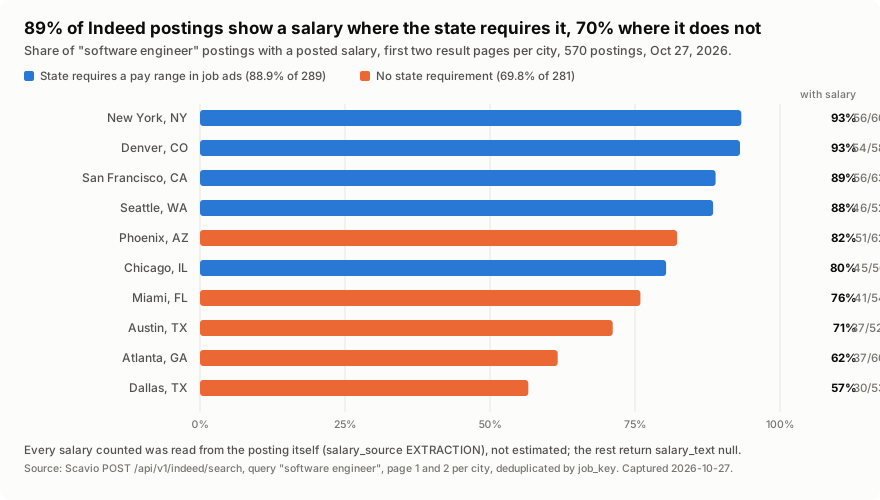
Of 570 unique postings, 453 (79.5%) showed a salary. The split follows state law: in the five cities whose state requires a pay range in job postings (New York, Colorado, California, Washington and Illinois), 257 of 289 postings had one, or 88.9%. In Texas, Georgia, Florida and Arizona, 196 of 281 did, or 69.8%. New York and Denver led at 93%, and Dallas was lowest at 57%. Where a salary was posted, the ranges differed widely by city: the median midpoint of yearly ranges on software and developer titles was $215,000 in San Francisco and $185,000 in New York, against $116,896 in Dallas. If you benchmark pay, a third of a Dallas sample has nothing to benchmark, so the share with a salary is a number to report alongside the band.
One more thing the capture showed: Indeed mixes sponsored postings into results, and 247 of the 570 (43%) were sponsored, including behavior technician and graphic designer roles in a software engineer search. Scavio flags each row with sponsored, so you can drop them before counting.
1. Scavio: live postings with salary, employers and reviews
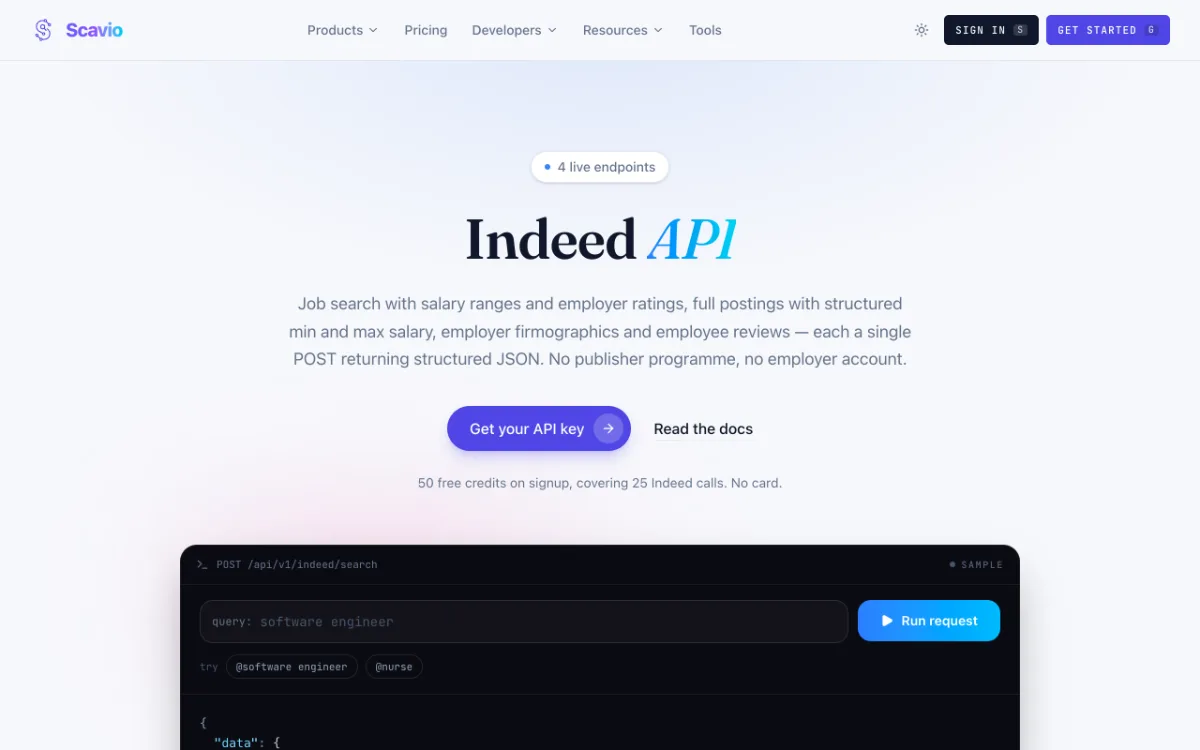
Scavio's Indeed API is 4 POST endpoints on indeed.com, each 2 credits. Measured on October 27:
- Search: "software engineer" in New York returned 45 postings on page 1 in 3.8 s, with
total_results3,518 andunique_results2,784 after Indeed collapses duplicate listings. Each row has title, employer, the employer's rating and review count, location, salary text and numbers, job types, benefits, posting date,apply_countandsponsored. Filters cover radius, posting age (1, 3, 7 or 14 days), job type, minimum salary and remote. Across 20 searches the median response time was 3.4 s, with a range of 2.3 to 25.3 s. - Job detail: Adobe's Software Development Engineer posting in New York returned the full description as text and HTML,
salary_min114,100 andsalary_max214,950 a year, employment type,valid_throughand the employer's 4.2 rating from 875 reviews, in 6.3 s. - Employer profile: Adobe's profile listed 178 open jobs, headquarters, founding year, revenue band, a 70% CEO approval, five category ratings and employee-reported salaries, such as $161,068 for Software Engineer from 32 reports.
- Employee reviews: 20 reviews a page with rating, text and per-category scores, plus topic counts; Adobe had 479 written reviews across 875 ratings.
What it does not do: Indeed calls cost 2 credits, double most Scavio platforms. Page 1 holds 36 to 45 postings but later pages hold 15 to 25, and sponsored rows need filtering. Salary appears only where the posting states one; there is no estimate on search rows. Coverage is indeed.com, with no parameter for country sites such as indeed.co.uk. The benefit is one key and one JSON format for Indeed alongside Glassdoor salaries and LinkedIn jobs, plus an MCP server for agents. How to get Indeed job postings through an API walks through each call with captured responses.
2. Apify actors: the lowest price per job for batch runs
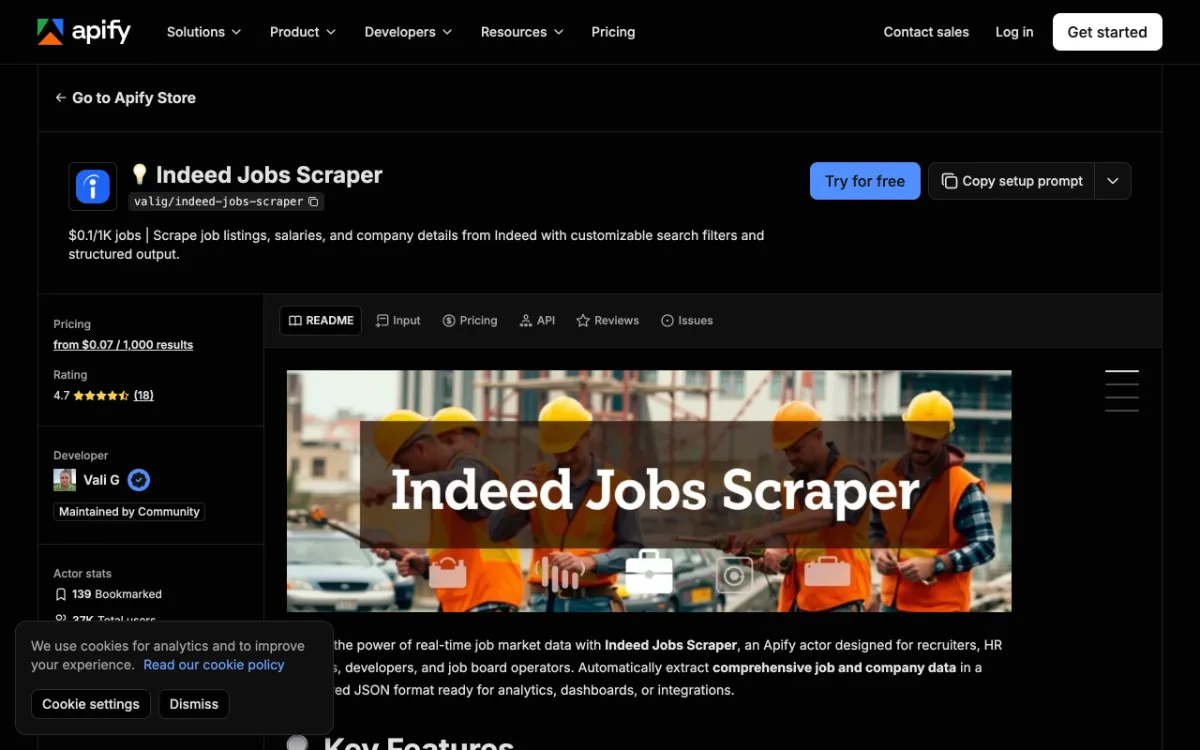
On the Apify Store, valig/indeed-jobs-scraper has 36,737 users, a 4.73 rating and charges $0.10 per 1,000 jobs, from $0.07 on higher Apify plans. Its output includes baseSalary with min, max, unit and currency, employer details and job attributes. The older misceres/indeed-scraper has 32,206 users and costs from $3.00 per 1,000 listings. Actors run as jobs that write to a dataset, which suits nightly exports better than a call inside a user request, and Apify's free plan includes $5 of usage a month. Both are community-maintained, so pin the one you test.
3. Bright Data: bulk job and company records
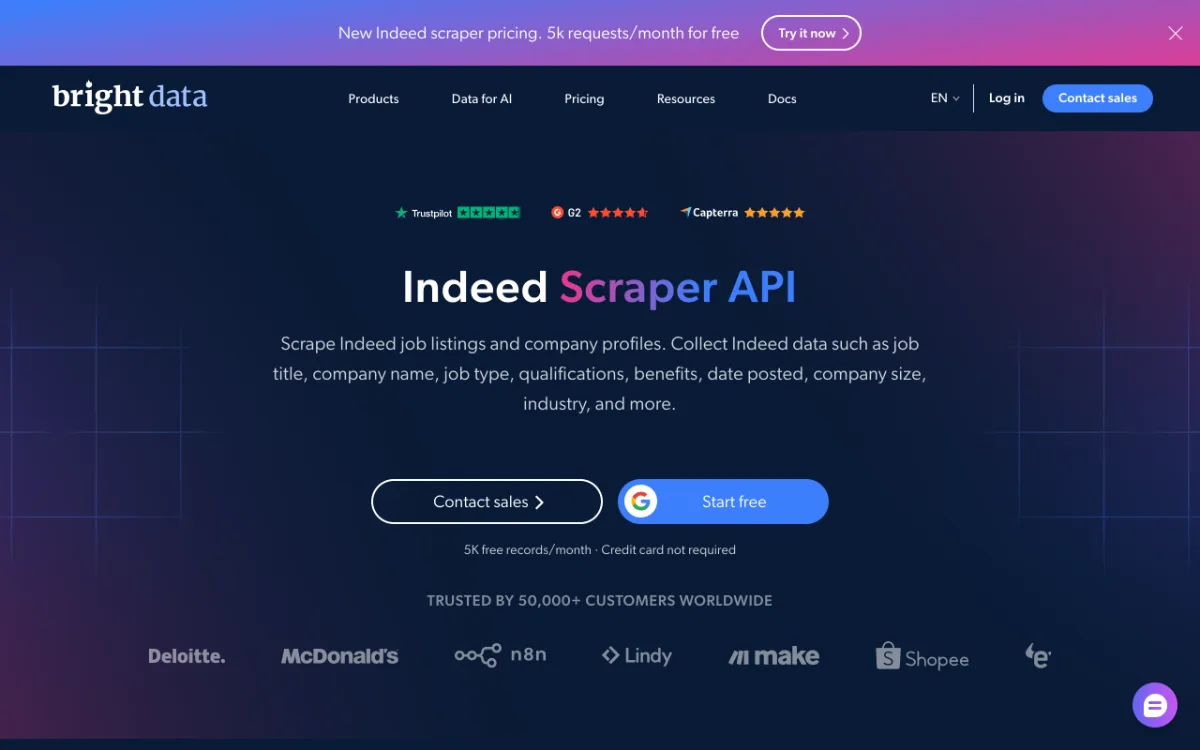
Bright Data's Indeed Scraper API has collectors for job listings (by keyword and location, or by company URL) and for company profiles (by list, industry and state, or name). The listed job fields are job id, company, date posted, title, description, benefits, qualifications and job type; salary is listed for its separate Indeed Job collector. It costs $1.50 per 1,000 records pay-as-you-go, or $499 a month for 384,000 records with more at $1.30 per 1,000, and includes 5,000 free records a month with no card. Choose it when the deliverable is a large file of records rather than an answer inside a request.
4. Oxylabs: raw Indeed pages for your own parser
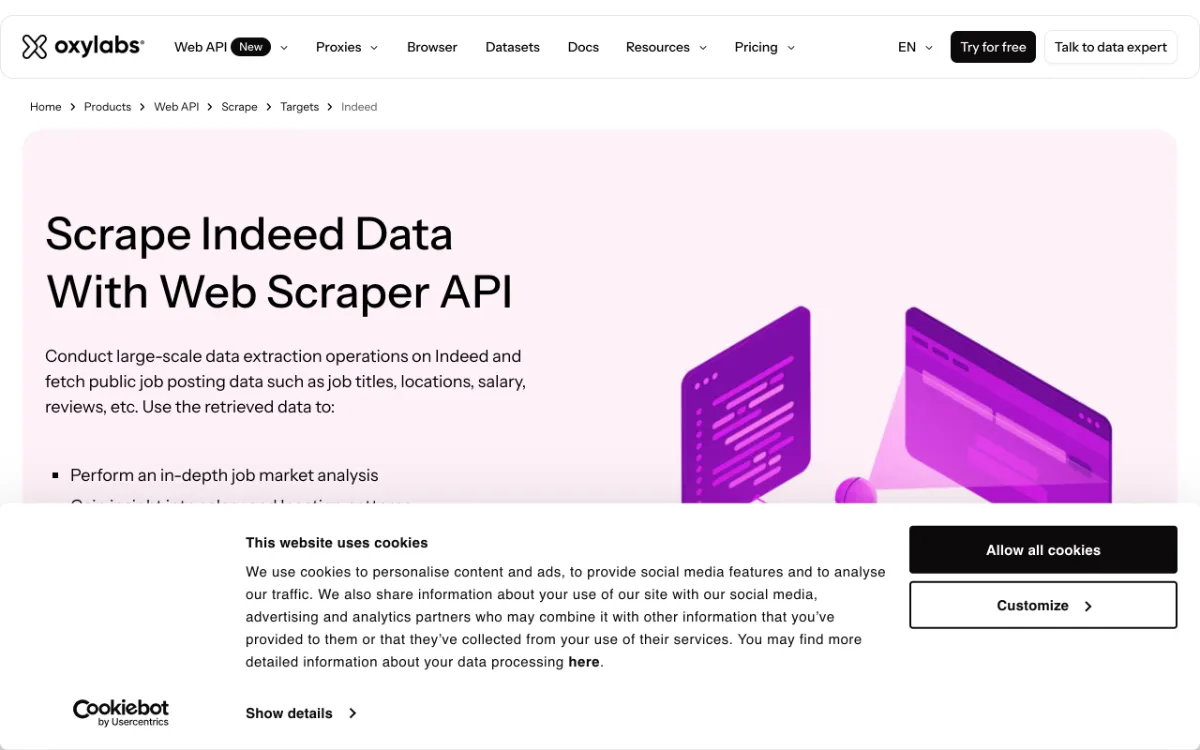
Oxylabs' Indeed Scraper API is a target of its general Web Scraper API, and its page says results come back in HTML format, with parsing left to you or to its custom parser tools. Pricing for other websites starts at $1.00 per 1,000 results on the $30 Starter plan, falling to $0.75 at volume, with $5 of welcome credits. Choose it if you already run Oxylabs and want to own the parsing.
5. JobsPipe: Indeed in a multi-board index
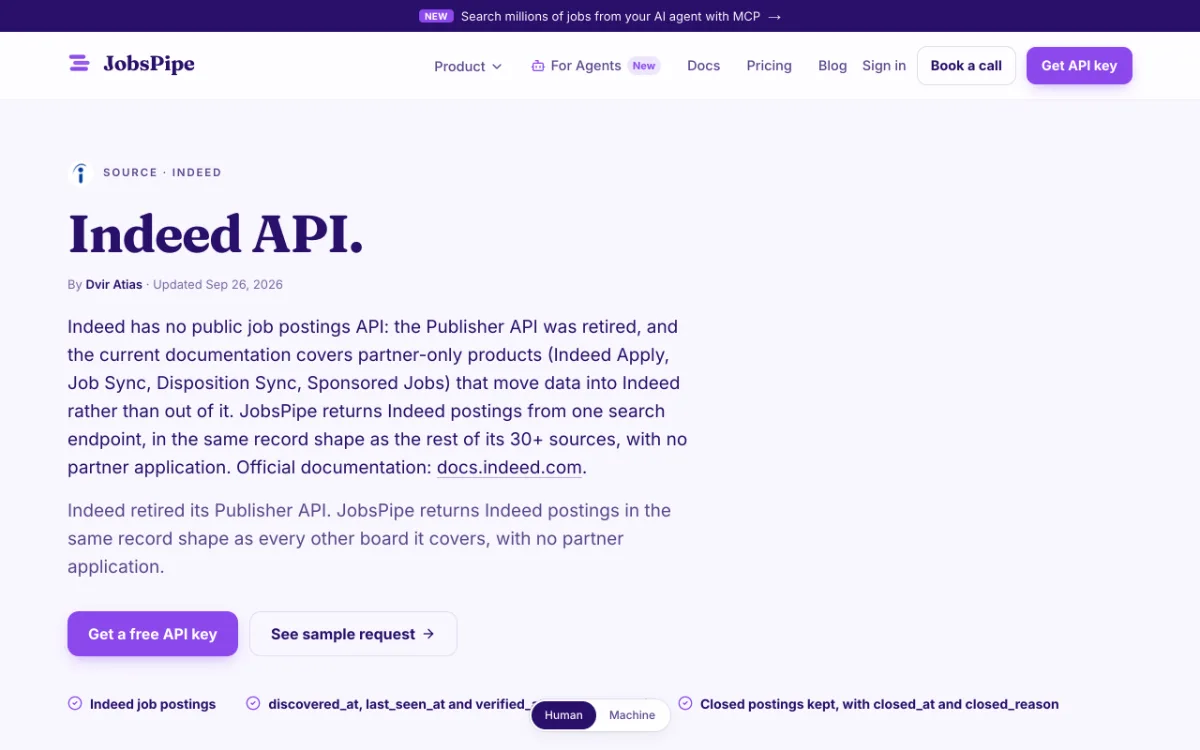
JobsPipe returns Indeed postings from its own search endpoint in the same record shape as its other 30+ sources, filtered with "source_or": ["indeed"]. Salary is parsed into minimum and maximum annual USD where the posting states a range, and records carry discovered_at, last_seen_at and verified_at. Pricing is per job returned: 1,000 free once, $19.60 a month for 10,000, and $525 for 500,000 ($1.05 per 1,000). Freshness ranges from 24 hours on the free plan to under an hour on Scale. Choose it when you want many boards in one schema and can work from an index rather than a live search.
Piloterr, TheirStack and several RapidAPI listings also sell Indeed job data; check how each prices a search page against a single posting before you compare.
Pick by the number you need
If your users act on live postings and pay ranges, keeping that data current is the ongoing work, and it is what Scavio's Indeed API handles. Tracking 50 role-and-city searches every day, two pages each, is 100 calls and 200 credits a day, about 6,000 a month. That is $12 at the Growth-yearly rate of $2 per 1,000 credits, and two pages returned 52 to 63 unique postings per city in our test, so it covers roughly 2,800 postings a day with salary, employer rating and posting date on each. Pulling full descriptions for 100 new postings a day adds another 6,000 credits a month. Try the Indeed API free, 50 credits, no card, or run a search in the playground.
Reference: all 4 Indeed endpoints · search docs · how to get Indeed job postings · is the Indeed API still available?
Frequently asked questions
Does Indeed have a public API for job postings?
No. Indeed's partner documentation at docs.indeed.com covers the Job Sync API, the Job Update API, Indeed Apply and a Publisher JavaScript Plugin, all for ATS partners, agencies, employers and publishers who move jobs and applications into Indeed or display them on a site. None of them returns search results to read. The old Publisher job search documentation now redirects to Indeed's engineering blog. To read public postings as JSON, use a third-party API such as Scavio's Indeed API.
Is there a free job listing API available?
Several Indeed data APIs have a free allowance. Scavio gives 50 credits on signup with no card, which is 25 Indeed calls. Bright Data includes 5,000 free records a month, JobsPipe gives 1,000 jobs once, Oxylabs gives $5 in welcome credits and Apify's free plan includes $5 of usage a month for running actors.
What is the cheapest Indeed scraper API?
Per posting, the cheapest options checked on October 27, 2026 were Apify's valig Indeed Jobs Scraper at $0.10 per 1,000 jobs and Scavio, where a first-page search returned 36 to 45 postings for 2 credits, about $0.10 per 1,000 postings on the Growth plan billed yearly. Bright Data charges $1.50 per 1,000 records, JobsPipe $1.05 to $1.96 per 1,000 jobs depending on plan, and Oxylabs from $1.00 per 1,000 results returned as raw HTML.
Can I get salary data from Indeed through an API?
Yes, where the employer posts one. Of 570 software engineer postings we pulled across ten US cities on October 27, 2026, 453 (79.5%) carried a salary. Scavio returns it on every search row as salary_text plus numeric salary_min, salary_max, salary_period and salary_currency, so you can aggregate a pay band without parsing strings.
Can I scrape Indeed legally?
Job postings on Indeed are public, but Indeed's terms restrict automated access, and how you store and republish the data matters as much as how you collect it. APIs like these return public posting and employer data without logging in as a user. Check Indeed's terms and talk to your own counsel about your specific use, especially if you plan to republish postings.