

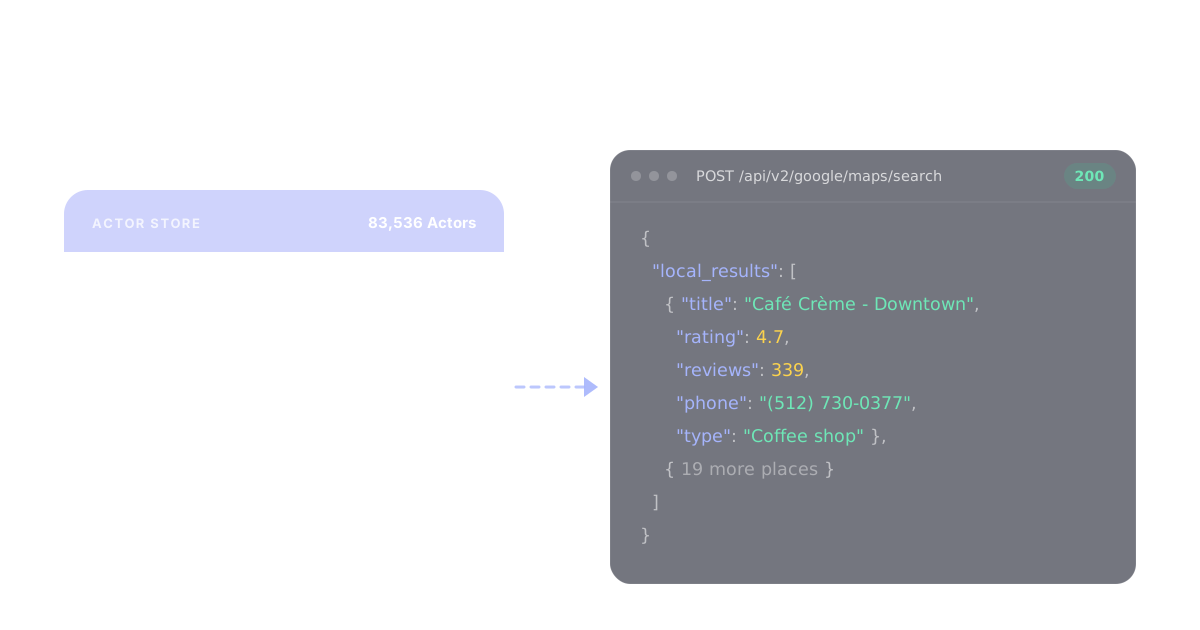
If you use Apify for its popular Instagram, TikTok or Google Maps scrapers, the closest swap is Scavio: a fixed endpoint such as POST /api/v2/google/maps/search returns 20 places for 1 credit in one request (Scavio starts from $2 per 1,000 requests), with no Actor runs to start or datasets to collect. Choose Bright Data for bulk record delivery, Firecrawl for crawling any site into Markdown, Octoparse for point-and-click scraping, Zyte for an unblocking API under your own code, and Crawlee if you want Apify's own open-source crawler on your own servers.
We build Scavio, so that recommendation comes with an obvious bias. To keep it honest: every price below was read off the vendor's own page on October 7, 2026, Apify's Actor prices come from each Actor's pricing tab, every Scavio response in this post is a real capture from that day, and the section on Scavio includes the things it does badly. On Instagram profiles, Apify's own Actor is 7 to 9 times cheaper than we are.
Which Apify alternative fits your job?
Start with what you actually run on Apify. Most teams use a handful of popular Actors for a handful of sites, and the right replacement depends on whether those sites are fixed or arbitrary.
| Tool | Choose it for | Billing unit | Price (checked Oct 7, 2026) | Main thing to check |
|---|---|---|---|---|
| Scavio | Instagram, TikTok, Google Maps, Google Search and other fixed platforms inside an app or agent | Per call | Starts from $2 per 1,000 requests on the Growth plan billed yearly (1-credit calls); an Instagram profile is usually 8 credits, so $16 per 1,000; $0.01 a credit pay as you go | Fixed endpoint set, no scheduler or storage |
| Bright Data | Bulk records delivered to cloud storage | Per record | $1.50 per 1,000 records; 5,000 free records a month | Collector setup and delivery config |
| Firecrawl | Crawling any website into Markdown or JSON | Per page | 1,000 free credits a month; Hobby $19 a month for 5,000 | Generic pages, no platform-specific fields |
| Octoparse | Point-and-click scraping with templates | Subscription | Free plan; Standard from $69 a month billed annually | Task limits per plan |
| Zyte | An unblocking API under your own scrapers | Per 1,000 successful responses | $0.13 to $16.08 per 1,000 pay as you go, by site difficulty | You still write the parsing |
| Crawlee | Apify's open-source crawler on your own servers | Free | Free under Apache-2.0; you pay for servers and proxies | You own blocking, parsing and scheduling |
Marketplace Actors, maintained endpoints or your own code
Apify is a marketplace. Its store lists 83,536 Actors, each a program published by a developer who sets its price and keeps it working. Apify runs them, schedules them, stores their output in datasets and bills you through a plan: Free with $5 of monthly usage, Starter at $19 a month, Scale at $199 and Business at $999, with platform compute at $0.2 per compute unit (1 GB of RAM for an hour) on the two lower plans.
Most popular Actors now use pay-per-event pricing: a fixed price per result, discounted by plan. The pricing page names the discount tiers (Starter gets "Bronze", Scale "Silver", Business "Gold"), and the headline "from" price on an Actor's page is the Business-plan rate, not what a Starter account pays. Optional extras, such as filters or contact enrichment, are billed as separate events on top.
That model is Apify's biggest strength and its main cost. You can find an Actor for almost any site, but for a popular one you choose among several competing Actors, each with its own price, its own output shape and its own maintainer. The alternatives split into three answers to the question "who fixes it when the site changes?":
- A vendor that maintains fixed endpoints (Scavio, Bright Data's Scraper APIs). One team owns each platform, the response shape stays put, and you lose the long tail of niche sites.
- A generic extraction service (Firecrawl, Zyte, Octoparse). Works on any site, but you get pages or rendered HTML, and the fields are yours to define.
- Your own code (Crawlee). Nothing to pay per result, and everything to maintain.
What 1,000 records cost: Apify's top Actors vs Scavio
The most searched Apify scrapers are its Instagram, TikTok and Google Maps Actors, so we priced the same three jobs on both sides. Apify's prices are each Actor's Starter-plan rate per result. Scavio's are the credits per call times $0.002 on the Growth plan billed yearly ($399 a month for 200,000 credits) or $0.01 pay as you go, using the records per call we measured.
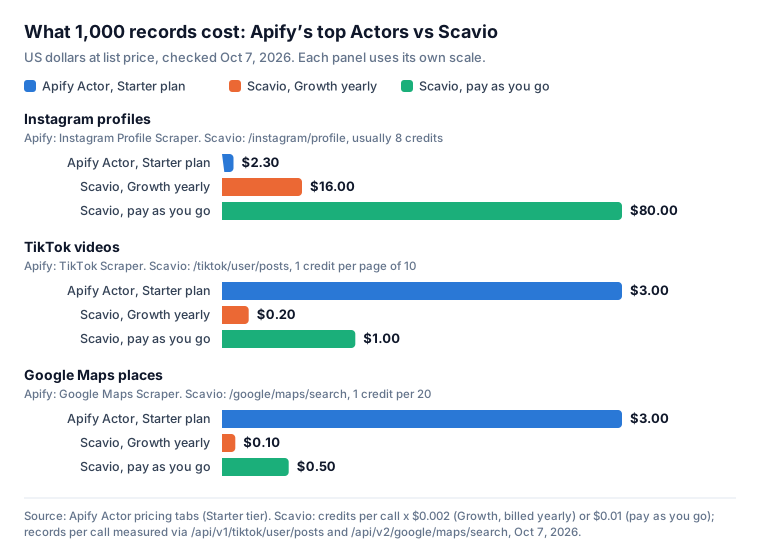
| Job | Apify Actor (users) | Apify, Starter plan | Scavio call | Records per call | Scavio, Growth yearly | Scavio, pay as you go |
|---|---|---|---|---|---|---|
| Instagram profiles | Instagram Profile Scraper (240,106) | $2.30 | /api/v1/instagram/profile, usually 8 credits | 1 | $16.00 | $80.00 |
| TikTok videos | TikTok Scraper (311,204) | $3.00 | /api/v1/tiktok/user/posts, 1 credit | 10 | $0.20 | $1.00 |
| Google Maps places | Google Maps Scraper (637,956) | $3.00 | /api/v2/google/maps/search, 1 credit | 20 | $0.10 | $0.50 |
The result cuts both ways, and the shape of the response explains it.
Instagram profiles are much cheaper on Apify. Apify's Instagram Profile Scraper charges $2.30 per 1,000 profiles on Starter ($2.60 on the Free plan). A Scavio profile request is usually 8 credits and can reach 10; both of our test calls (natgeo and nasa) were billed 8 credits and answered in about 2 seconds. That is $16 per 1,000 profiles on the Growth plan billed yearly, or $80 pay as you go. If profiles are most of your volume, Apify or Bright Data is the better buy.
TikTok videos and Maps places are cheaper on Scavio, because one call returns a page of records rather than one. Two pages of National Geographic's TikTok videos returned 10 videos each for 1 credit, in 2.4 and 2.5 seconds. Two pages of "coffee shops in Austin, TX" returned 20 places each for 1 credit, in 5.7 and 6.1 seconds. Apify's TikTok Scraper charges $3.00 per 1,000 results on Starter, plus small add-on events for date or popularity filters; its Google Maps Scraper charges $3.00 per 1,000 places, plus $0.001 per place for each filter and $0.002 per place for contact enrichment.
The records are not identical, so compare fields before you compare prices. Apify's Maps record comes from the place page; Scavio's search record is the list result. In our Austin capture all 20 places carried a rating, review count, address, coordinates and place ID, 19 of 20 carried a website and opening hours, and 13 of 20 a phone number. For the full place page, /api/v2/google/maps/place costs 1 more credit per place, $2 per 1,000 places on the Growth plan billed yearly.
1. Scavio for fixed platforms inside your app
Scavio is a REST API with one endpoint per job, so it fits when the data feeds code: an agent tool, a lead pipeline, an n8n workflow. Each call returns in the same request, with no run to poll. These are the endpoints that cover the popular Apify scrapers, with their real credit costs:
| Replaces | Endpoint | Returns | Credits |
|---|---|---|---|
| Apify Instagram Scraper (profiles) | /api/v1/instagram/profile | Followers, following, post count, bio, link | Usually 8 (2 to 10) |
| Apify Instagram Scraper (posts) | /api/v1/instagram/user/posts | A page of a user's posts | 2 to 10 |
| Apify TikTok Scraper (profiles) | /api/v1/tiktok/profile | Followers, likes, video count, sec_uid | 1 |
| Apify TikTok Scraper (videos) | /api/v1/tiktok/user/posts | A page of videos with play, like and comment counts | 1 |
| Apify Google Maps Scraper | /api/v2/google/maps/search | 20 places per page | 1 |
| Apify Website Content Crawler (one page) | /api/v1/extract | One URL as Markdown, text or HTML | 1, or 2 on the hardest tier |
A Maps pull is a loop over pages, with a dedupe step:
import os
import requests

API = "https://api.scavio.dev/api/v2/google/maps/search"
headers = {"Authorization": f"Bearer {os.environ['SCAVIO_API_KEY']}"}

places = {}
for start in (0, 20):
    r = requests.post(
        API,
        headers=headers,
        json={"query": "coffee shops in Austin, TX", "gl": "us", "hl": "en", "start": start},
        timeout=90,
    )
    for p in r.json()["local_results"]:
        places.setdefault(p["place_id"], p)

print(len(places))
And one place from the response, trimmed to the fields most lead lists keep:
{
  "position": 2,
  "title": "Café Crème - Downtown",
  "place_id": "ChIJ0QbsjcW1RIYRJxQSKO9kl8A",
  "rating": 4.7,
  "reviews": 339,
  "type": "Coffee shop",
  "address": "710 W Cesar Chavez St, Austin, TX 78701",
  "phone": "(512) 730-0377",
  "website": "https://cafecremeaustin.com/locations/downtown"
}
The Instagram profile endpoint returns a flat object; our natgeo capture, trimmed:
{
  "username": "natgeo",
  "full_name": "National Geographic",
  "follower_count": 268423562,
  "following_count": 194,
  "media_count": 32052,
  "is_verified": true,
  "external_url": "http://visitstore.bio/natgeo"
}
What Scavio does badly, from the same day's testing:
- Instagram is expensive. A profile is usually 8 credits, as on both of our calls, so $16 per 1,000 on the Growth plan billed yearly, against $2.30 per 1,000 on Apify's Starter plan.
- The endpoint set is fixed. If a site is not on the list, the only fallback is Extract, which reads one URL per call and does not follow links or crawl a domain. Apify, Firecrawl and Crawlee all crawl.
- No scheduler, no storage. There are no datasets, no saved runs and no cron. You call the API from your own job and keep the results yourself.
- Page sizes are what the platform gives. We asked the TikTok videos endpoint for 30 per page and got 10, twice. Page two of the Maps search repeated one place from page one, so dedupe on
place_id. - TikTok responses are large. Each page carries TikTok's full video objects, about 600 KB for 10 videos, so keep only the fields you need.
- Pay as you go has a floor. Credits cost $0.01 each, sold in a minimum purchase of 2,500.
What the difference buys is one key and one response style across Instagram, TikTok, Google Maps, Google Search, Amazon, YouTube, Reddit, LinkedIn and more, plus an MCP server for agents. Our Apify alternatives overview has the feature-by-feature comparison.
2. Bright Data for bulk records
Bright Data sells per-platform Scraper APIs, including Instagram, TikTok and Google Maps. Pricing is $1.50 per 1,000 records pay as you go, with 5,000 free records a month and no card required; the Scale plan is $499 a month for 384,000 records and $1.30 per 1,000 after that. Records arrive as JSON, NDJSON or CSV, through the API, a webhook or cloud storage such as Amazon S3 or Google Cloud Storage.
At that rate it undercuts Apify's Starter tier on all three jobs above, and undercuts Scavio on Instagram profiles. Choose it when the job is "deliver a large file of records", not "answer a request in the middle of my app".
3. Firecrawl for crawling any site
Firecrawl is the answer when your Apify workload is the Website Content Crawler rather than a platform scraper: point it at URLs or a whole domain and get Markdown or structured JSON for an LLM. Pricing is 1 credit per page: the free plan has 1,000 credits a month, Hobby is $19 a month for 5,000, and Standard is $83 a month billed yearly for 100,000.
It reads pages, not platforms, so an Instagram profile comes back as page content rather than a follower_count field. We compared its costs in more depth in Firecrawl cost vs alternatives.
4. Octoparse for point-and-click scraping
Octoparse lets non-developers build scrapers by clicking on a page. The free plan includes 10 tasks and 50,000 exported rows a month. Standard starts at $69 a month billed annually, with 100 tasks, 500+ preset templates, task scheduling and up to 3 concurrent cloud processes; Professional is $249 a month billed annually. Some templates are billed per result, at $0.001 to $3 per thousand.
Its templates play the role of Apify's ready-made Actors for people who do not want to write or call code. Plans are capped by task count, so size it by how many separate sites and layouts you scrape.
5. Zyte for unblocking under your own scrapers
Zyte, the company that maintains Scrapy, sells the Zyte API: you send a URL, it returns the page after handling bans and rendering. Pay-as-you-go pricing runs from $0.13 per 1,000 HTTP responses on the simplest sites to $16.08 per 1,000 browser-rendered responses on the hardest, with lower rates on monthly commitments from $100, and a $5 free trial credit.
Choose it if you already write Scrapy spiders and only want the blocking problem solved. Parsing, scheduling and storage stay with you.
6. Crawlee for Apify's own crawler on your servers
Crawlee is Apify's open-source crawling library for Node.js, with 26,035 GitHub stars and an Apache-2.0 license; Crawlee for Python has 9,580 more. The latest Node release, v3.18.2, shipped on September 29, 2026. It gives you HTTP and headless browser crawling, a persistent URL queue, proxy rotation, retries and browser-like fingerprints, and it runs anywhere, not only on Apify.
It is the cheapest option per record and the most expensive in your time: you supply proxies, fix selectors when Instagram or Google change their pages, and build the scheduling and storage that Apify gave you. It is a good choice when scraping is core to your product and you have someone to own it.
Checklist before switching off Apify
- Price your real tier. Look up the Actor's price for your plan, not the "from" price, and add every add-on event your input triggers.
- Count records per call. A per-call API is cheap when one call returns a page (20 Maps places) and expensive when it returns one record (an Instagram profile).
- Diff the fields. Run 20 records of your real input through both tools and compare field by field, as we did with phone and website coverage above.
- Replace what Apify did for you. Schedules, datasets, webhooks and retries come with Apify. With an API you rebuild them in a cron job and a database.
- Check who maintains it. For a marketplace Actor, that is its developer; pin the exact Actor you tested and watch its changelog.
- Check how failures are billed. Ask what happens to a timed-out run or a failed call before you size the budget.
Frequently asked questions
Is there anything better than Apify? It depends on the job. For fixed platforms called from code, a maintained API such as Scavio returns Instagram, TikTok or Google Maps data in one request with no runs or datasets; for bulk files, Bright Data's Scraper APIs list at $1.50 per 1,000 records. For niche sites, scheduled crawls and custom logic, Apify's breadth is hard to beat.
Is there a free version of Apify? Yes. Apify's Free plan costs $0, needs no credit card and includes $5 of usage a month, which covers roughly 1,900 Instagram profiles at the Free-tier Actor price of $2.60 per 1,000. Crawlee, Apify's open-source library, is free to run on your own servers, and Scavio gives 50 free credits on signup.
Is Apify Google Maps scraper legal? This is not legal advice. Collecting public business listings is widely done, but Google's Terms of Service restrict automated access that ignores its instructions, and scraped reviews can contain personal data covered by laws such as GDPR. US courts have treated public data differently from data behind a login, as in hiQ v. LinkedIn, so check with counsel before storing reviewer data at scale.
Is Apify a good scraper? Yes, for breadth and control. Its most popular Actors report high success rates on their own pages (98.4% of runs for the Google Maps Scraper, 99.3% for the TikTok Scraper), and the platform adds scheduling, storage and webhooks. The trade-off is that quality and price vary by Actor developer, and the bill combines a plan, per-result events, add-ons and compute.
Skip the Actor bookkeeping
If you stay on the marketplace model, you own the parts this post kept running into: choosing among competing Actors for each site, tracking each developer's price and output changes, working out which tier and add-on events apply to your plan, adding compute units for pay-per-usage Actors, and wiring runs, datasets and webhooks back into your app.
Scavio absorbs that for the platforms it covers. You send a query or a username and get the same JSON shape back in the same request, from endpoints one team maintains, with one key for Instagram, TikTok, Google Maps and the rest.
Scavio starts from $2 per 1,000 requests on the Growth plan billed yearly ($399 a month for 200,000 credits), the rate for the 1-credit endpoints most calls use; an Instagram profile is usually 8 credits, so $16 per 1,000. To start small, pay as you go at $0.01 a credit (2,500-credit minimum), or take the Project plan at $30 a month for 7,000 credits. Tracking 200 TikTok creators every week, with one profile call and one page of videos each, is 400 credits a week, about 1,730 a month, which fits inside the Project plan; a 1,000-place Google Maps list is about 50 credits, or $0.10 at the Growth rate.
Get an API key with 50 free credits, no card required, and run your top Apify job through the matching endpoint before you decide.