

Not by the measure the thread used. On November 18, 2026, we read the listings for sale and the sold listings of 25 brands on Poshmark US and divided each price by the original price the seller entered. The median brand's listings asked 36% of that original price, not the 85% that "15% off original price" implies, and its sold listings showed 29%. New with tags listings asked 47% and sold at 40%; everything else asked 34% and sold at 25%. Sold sat below asking in 21 of the 25 brands. Both sides came from POST /api/v1/poshmark/brand on Scavio's Poshmark API.
The question comes from r/poshmark, where a buyer posted "What is with prices today?" on September 23, 2026; when we read it on November 18 it had 118 upvotes and 59 comments. The poster wrote that "People are selling stuff for like 15% off original price" and that by the time they pay shipping they "might as well buy brand new". The replies are experiences, not data, and they are the commenters' own: the top one (80 points) said "Most sellers price anywhere from 20-30% above what they'd actually sell for", another (46 points) that people "mark up to account for the poshmark fee", a seller (19 points) asked buyers to "use the offer button", and another (17 points) recalled items such as "anything in a limited color from Lululemon" that "could sell close to or over retail". A second thread, "I rejected an offer, then received this message" (September 18, 140 upvotes, 159 comments), argues the same thing from the seller's side for a factory-wrapped item listed at 50% off its retail price.
Every listing on Poshmark can carry an original price next to its price, and Poshmark's Make an Offer help says "The price of the sold listing will reflect the amount of the final order price". So the checkable part of the question is: what share of the original price do listings ask, and what share do sold listings show? We checked that.
How we compared
We took the brands from Poshmark itself: the first 25 of its own top-50 brand list, skipping "Vintage", which is not a brand, and the two luxury houses on the list. For each brand we read pages 1 and 2 of its listings for sale and of its sold listings on Poshmark US with brand, up to 96 of each in Poshmark's relevance order, plus page 1 of each side filtered to new with tags, between 09:57 and 10:11 UTC: 150 calls, 1 credit each. For each listing we divided the price by the original price the seller entered, took each brand's median, then the median across brands. The caveats, which matter here:
- Most listings show no original price. 3,866 of the 6,131 unique listings we read (63%) had none, so every share covers the 37% that do. 14 listings whose original price was below their price were dropped.
- The original price is the seller's own figure, not a verified retail price. In another r/poshmark thread, sellers describe inflating it, which would make every share here look lower than a share of the real retail price.
- Condition is what the seller set. 1,352 of the 6,131 listings (22%) had none; they count as "not new with tags".
- The sold price is the price shown on the sold listing. Offers are private, so we cannot see what was offered, only the price the sold listing shows.
What the prices show
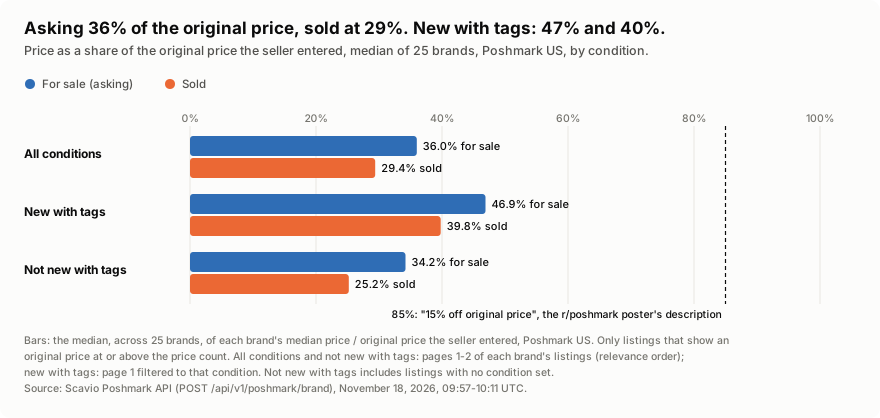
- "15% off original price" was not the typical listing. The median brand's listings asked 36.0% of the original price the seller entered. Even the highest brand median, Free People's, was 50.0%, and the highest new with tags median was 71.7% (Nike, on 11 listings that showed an original price).
- Sold listings showed less than listings ask. The median brand's sold listings showed 29.4%, and sold was below asking in 21 of 25 brands. Asking at 36.0% against sold at 29.4% puts the asking share 22% above the sold share, inside the "20-30%" the top commenter gave, though these are different listings rather than the same items before and after an offer, so it is not a measure of how far any one seller came down.
- New with tags is where prices sit closest to the original. New with tags listings asked 46.9% and sold listings showed 39.8%, below asking in 21 of 25 brands. Listings in other conditions asked 34.2% and sold at 25.2%. The new with tags medians rest on 8 to 37 listings per brand and side.
- Some brands asked more than others. Zara (48.2%), Disney (47.5%) and Free People (50.0%) asked the most; Michael Kors (26.7%), kate spade (27.0%) and J. Crew (27.5%) the least. The largest gaps between asking and sold were lululemon athletica (42.4% against 25.5%), Coach (43.0% against 27.5%) and Nike (42.0% against 26.7%).
- Some sellers do come down. 12.4% of the listings for sale (285 of 2,293) were priced below what they were first listed at, a median 20.0% lower.
- One check on the sold side. 413 of the 2,399 sold listings (17%) were marked sold within two minutes of being listed. We kept them; without them the median sold share is 25.9%, and the gap to asking widens rather than closes.
What this cannot tell you
- Why sellers price as they do, or whether any price is "too high" for a given item. We measured shares of the original price the seller entered, not fairness.
- What a buyer paid after shipping. Prices here leave out shipping, which the poster counted.
- Offers. Poshmark keeps offer amounts private; a sold listing shows the final order price, and a bundle discount may not show on each listing in it.
- Every sale. These are the listings Poshmark ranked first for each brand on one day, in its relevance order, not the latest sales or all of them.
- Other markets and brands. Poshmark US, 25 brands, one day.
Run the comparison yourself
curl -s https://api.scavio.dev/api/v1/poshmark/brand \
  -H "Authorization: Bearer $SCAVIO_API_KEY" \
  -H "Content-Type: application/json" \
  -d '{"brand": "Coach", "country": "us", "availability": "sold"}'
Send "availability": "available" for the listings for sale, add "condition": "new_with_tags" for the new with tags side, keep listings whose original_price is at or above price.amount, and compare the medians of price.amount / original_price. country ca runs the same on Poshmark Canada. How to get Poshmark sold listings walks through every call with captured responses, and the best Poshmark sold price APIs has the per-brand chart and the Canada comparison. Try the Poshmark API free: 50 credits read 50 pages.
This is price research, not buying or selling advice.
Frequently asked questions
Why are Poshmark prices so high?
We cannot measure why, only how far. On November 18, 2026, across 25 brands on Poshmark US, the median brand's listings for sale asked 36% of the original price the seller entered, and its sold listings showed 29%. Sellers set every price themselves, and buyers can send private offers.
Do Poshmark items sell for less than they are listed for?
In our read, sold listings showed a lower share of the original price than listings for sale in 21 of 25 brands. Poshmark says the price on a sold listing reflects the final order price, so an accepted offer shows there. These are different listings, though, not the same items before and after an offer.
Is the original price on Poshmark the retail price?
No. It is a figure the seller types in, it is optional, and Poshmark does not check it. 63% of the 6,131 Poshmark US listings we read for 25 brands had no original price, and sellers on r/poshmark say some inflate it.
Do new with tags items sell closer to the original price on Poshmark?
Yes, in our read. New with tags listings asked a median 47% of the original price the seller entered and sold listings showed 40%; listings in other conditions asked 34% and sold at 25%, medians across 25 brands on Poshmark US on November 18, 2026.
How can I check Poshmark prices with code?
Scavio's Poshmark API returns sold listings with POST /api/v1/poshmark/sold and listings for sale with search, 48 a page with the price, the original price the seller entered and the condition, for 1 credit a page; brand does the same for one brand. Divide price by original price and take the median.